
News
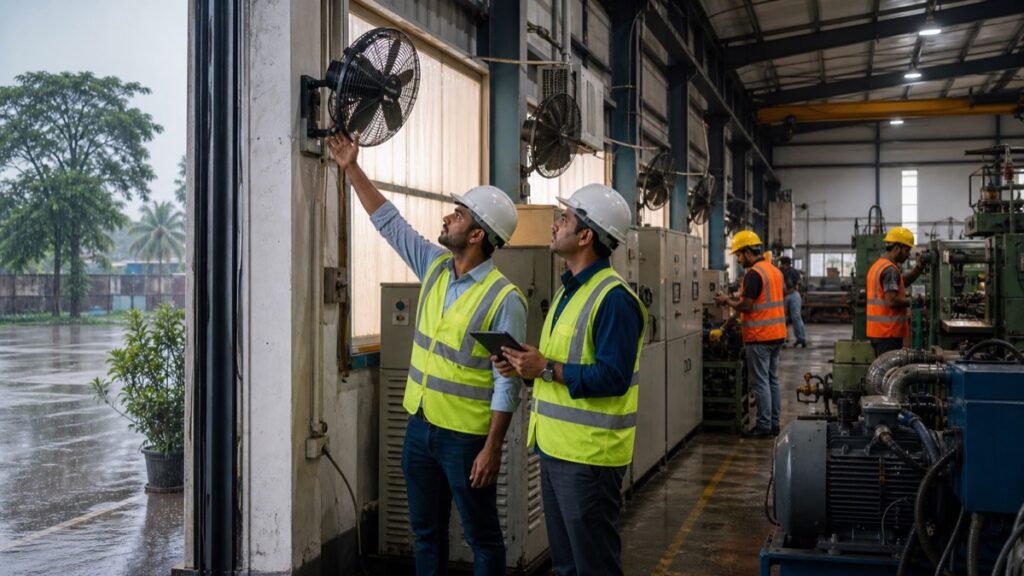
POPULA equipment cooling fan demand is gaining attention in South Asian manufacturing workshops as rainy-season humidity, machine heat, and long operating hours create new pressure on production environments. For many factories, the issue is not only general workshop ventilation. Motors, control cabinets, plastic machinery, packaging lines, and other equipment areas also need more stable airflow support.
In markets such as Bangladesh, India, Sri Lanka, and Pakistan, industrial workshops often operate through humid months with doors partially open, machinery running continuously, and workers moving between production lines. When the air becomes heavy and slow-moving, heat around equipment can remain longer, making localized cooling and targeted airflow more important.
For these conditions, POPULA helps project teams consider both general workshop air exchange and machine-side airflow. The goal is to choose fans based on real equipment location, airflow resistance, installation space, and worker operating zones, rather than simply adding small portable fans after a problem appears.
Why POPULA equipment cooling fan demand is rising in rainy-season workshops
During humid weather, factories often face a combination of heat and moisture. Production equipment releases heat continuously, while outdoor air may already be warm and humid. If the workshop has limited air movement, hot zones can form near motors, machine bases, electrical cabinets, or packing stations.
These site conditions are common in plastic processing, textile machinery, packaging, metalworking, and light assembly workshops. Some areas need wide air movement for people, while other points need more direct airflow toward equipment or a controlled exhaust path. That is why equipment cooling fan demand is becoming more specific than general ventilation demand.
Instead of asking for a single fan model, more project owners are now comparing axial fans, centrifugal fans, and localized ventilation layouts. This helps match the fan to the site problem: direct air delivery, ducted exhaust, general circulation, or a combination of several airflow layers.
Typical equipment cooling problems in manufacturing sites
Manufacturing workshops usually report several repeated problems before planning a fan upgrade:
- Heat staying around motor-driven machines and production equipment
- Weak airflow near control cabinets or machine-side work areas
- Humid air collecting around enclosed corners or equipment rows
- Portable fans being used temporarily without a clear airflow plan
- Need for reliable fans suitable for daily industrial operation
When these issues appear together, the solution may require both direct airflow and exhaust planning. In open areas, axial fans can help deliver air to specific work positions. In ducted or higher-resistance areas, centrifugal fans may be more suitable for moving air through a controlled route.
How POPULA fan products support equipment cooling applications
For direct airflow near machinery, EG axial fans can be considered where workers or equipment need stronger air movement in a defined area. This is useful near machine rows, loading points, or operating positions where general ventilation alone does not create enough wind sensation.
For wider industrial applications, SF(G) axial fans can also support air supply, exhaust, or general ventilation in factories and workshops. They are often used when the airflow path is relatively direct and the site needs practical installation with large air movement.
For machine-side exhaust or duct-connected airflow, the DF series multi-wing centrifugal fan is more suitable when air needs to move through ducts, hoods, or local collection points. This can help remove warm air from specific equipment areas instead of only mixing it into the workshop.
The best solution depends on the equipment layout. A packaging line may need direct air delivery to workers and motors, while a plastic machine area may need both local exhaust and wider air movement. POPULA recommends checking machine position, operating temperature sensitivity, installation height, power supply, and airflow path before final fan selection.
Equipment cooling is becoming part of workshop reliability planning
For many factories, fan selection is no longer only about comfort. Stable airflow can support daily production reliability by reducing stagnant hot zones, improving working conditions around equipment, and creating a more organized ventilation plan for humid months.
As South Asian manufacturing sites continue to expand, demand for more targeted industrial airflow solutions is expected to remain steady. Workshops that identify equipment cooling needs early can plan fan positions more clearly and reduce the need for temporary fixes later.
For equipment cooling, machine-side exhaust, and workshop ventilation projects, POPULA can provide selection support based on equipment layout, airflow direction, site resistance, and operating conditions. POPULA fan solutions can be adapted for direct airflow, ducted exhaust, and combined ventilation systems in humid manufacturing environments.