
Solutions
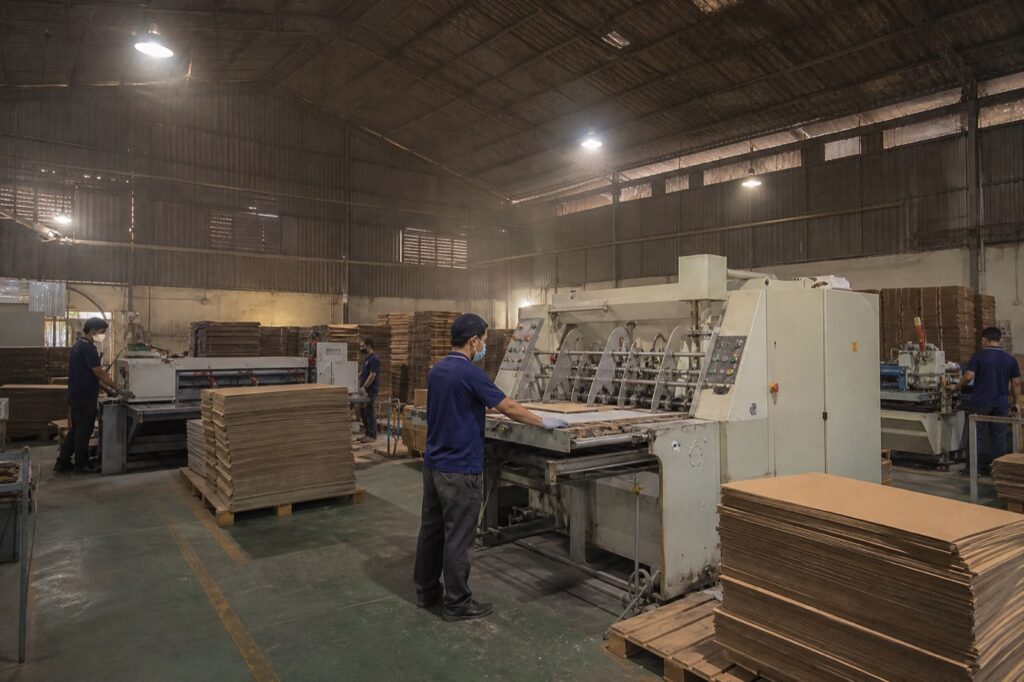
A corrugated carton workshop in Surabaya can generate lightweight paper dust at cutting, slotting and die-cutting stations while corrugating and conversion equipment add heat to a high-roof production floor. This POPULA Surabaya corrugated carton workshop ventilation solution uses JPY paper-carton machinery fans for source extraction, DWT-I roof axial fans for high-level heat discharge, and SF(B) axial fans for controlled airflow at stacking, packing and inspection positions.
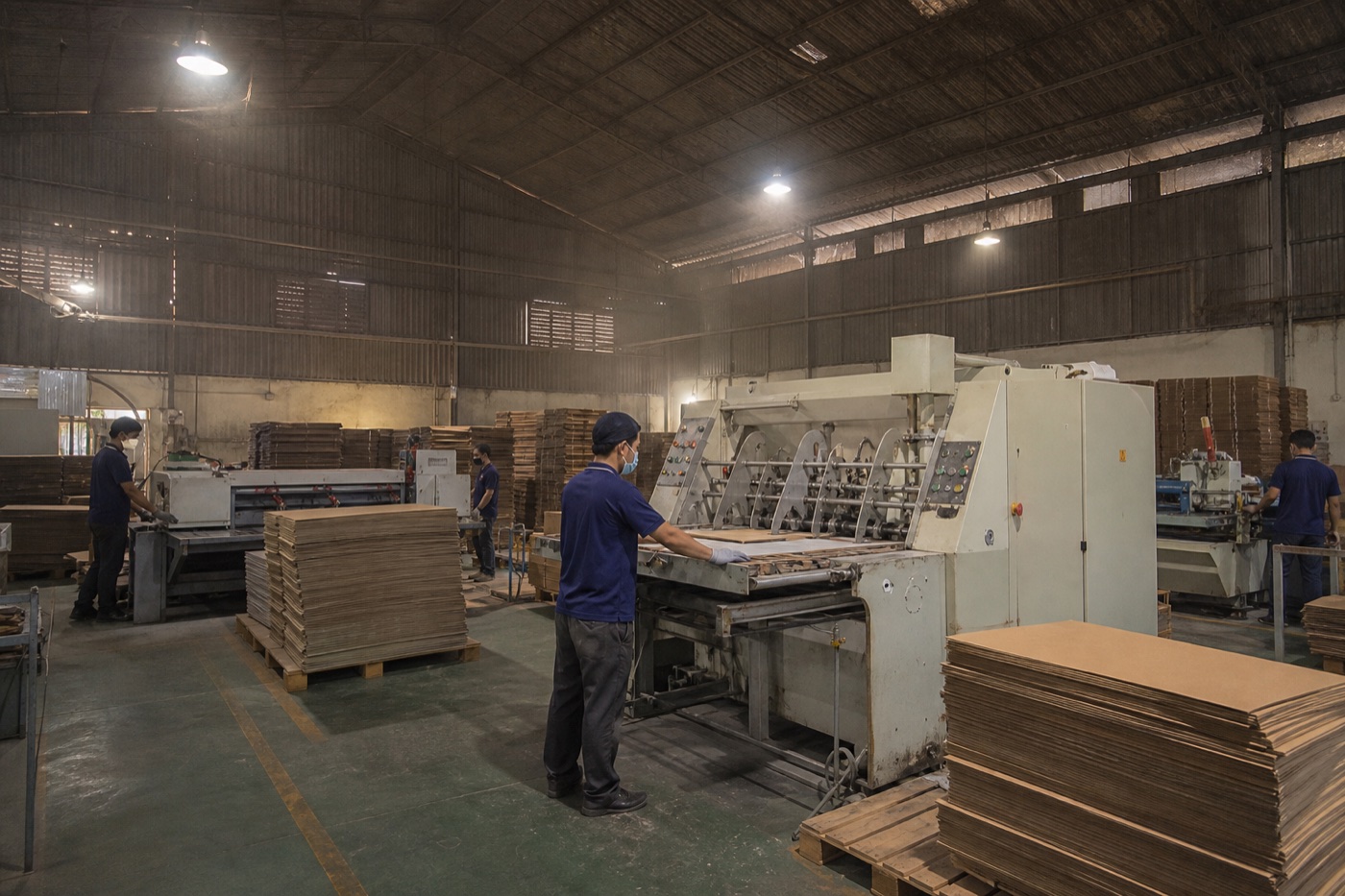
POPULA Surabaya corrugated carton workshop ventilation solution for paper converting
Paper dust is light, but it can travel through a workshop when it is not captured near the conversion equipment. General building ventilation may move some air, yet it does not replace a collection point at the source. At the same time, heat from machinery and the production process naturally rises to roof level, where it can remain if the building lacks sufficient high-level discharge.
The proposed project layout separates the three requirements: source capture near paper-dust generation, roof-level removal of accumulated heat and residual light dust, and lower-noise air movement for people working in stacking, packing and quality-inspection areas.
Why JPY, DWT-I and SF(B) fans suit different airflow duties
For the source-extraction layer, the primary recommendation is a JPY paper-carton machinery fan connected to collection hoods at cutting, slotting and die-cutting points. The JPY range is intended for paper-carton machinery applications and supports ducted extraction where dust accumulation and wear need to be considered. The conveyed gas should be non-combustible, contain no sticky material, remain within the specified particle-content limit, and not exceed 80°C.
Where the actual process, dust assessment or area classification requires a different approach, an HBJS aluminium-alloy fan can be evaluated for explosion-protection requirements, while a C6-46 dust centrifugal fan can be assessed as an alternative for relevant dust-extraction duties. These are alternatives to be selected against the real process conditions, not automatic substitutions for the JPY primary configuration.
For the roof layer, DWT-I fiberglass roof axial fans provide high-volume discharge of warm air and remaining lightweight dust at high points in the building. Their fiberglass construction supports corrosion resistance, and selected units can be configured within an airflow range up to 32,000 m³/h for the stated project conditions. The gas temperature should not exceed 60°C.
For personnel areas, SF(B) axial fans provide a practical local-airflow option. Fixed, adjustable and mobile forms allow the supply direction to be adapted around stacking, packaging and inspection tasks. The key is to direct local airflow away from the cutting and die-cutting collection hoods so it does not interfere with source capture.
How the three-level layout controls paper dust and heat
First, collection hoods are installed close to the paper-dust source and connected through duct branches to the JPY extraction fan. This aims to remove dust before it enters aisles, stacks of finished cartons or the roof space. Duct routes should be kept practical for inspection and cleaning, with the final duct size and fan pressure confirmed against the number of workstations, hood geometry, bends and discharge route.
Second, DWT-I units are arranged at roof high points to discharge accumulated warm air and residual light dust. The roof system supports the source-extraction layer rather than replacing it. Its placement should be coordinated with existing roof structure, weather protection, maintenance access and the available make-up-air path.
Third, SF(B) fans are placed around the packing and inspection area to provide targeted air movement for personnel. This layer is intentionally separated from the dust-generating stations, creating a clearer airflow route from the working zone toward the extraction and roof-discharge points.
Practical value for a Surabaya carton manufacturing facility
The combined arrangement gives each ventilation function a distinct role: JPY for source capture, DWT-I for high-level discharge, and SF(B) for personnel comfort. This helps site teams discuss equipment selection around the actual process instead of expecting one fan type to solve dust capture, roof heat and local worker airflow simultaneously.
POPULA supports industrial ventilation projects with airflow and pressure review, duct-layout discussion, application-based fan selection and export delivery coordination. Share the machine layout, dust sources, roof height, electrical supply and operating conditions with the project team for a more suitable solution.