
News
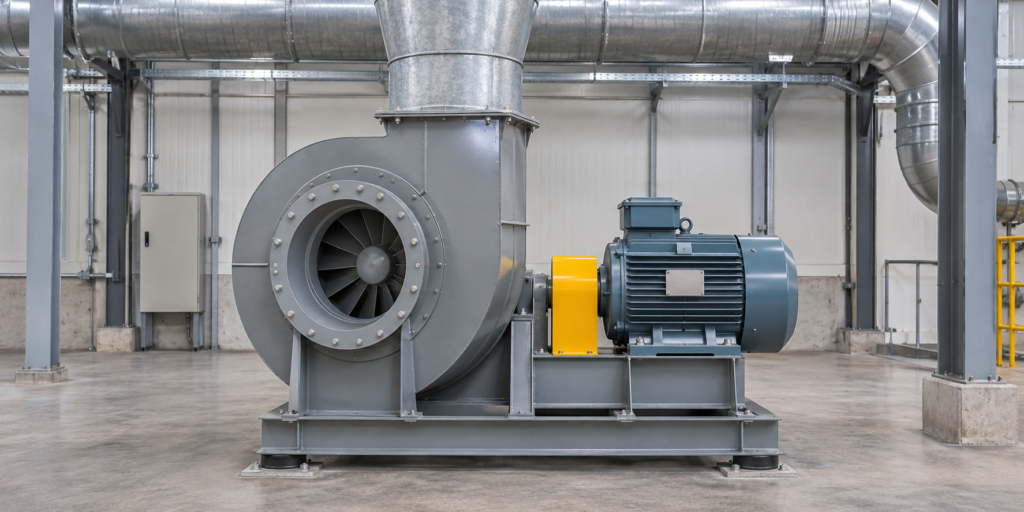
An industrial fan nameplate and a fan performance table describe related but different parts of an installation. The motor nameplate identifies the electrical and mechanical ratings of the motor fitted to the unit. The fan catalogue describes the fan model and its listed airflow and pressure data. Keeping these records separate helps prevent a motor rating from being mistaken for the fan’s delivered performance.
Motor nameplate data: identify the motor
Start by photographing the complete motor label clearly, then transcribe only the fields that are actually printed. Depending on the motor, these may include the manufacturer, model or frame, rated output, voltage, phase, frequency, current, speed, duty, insulation or enclosure information. Labels differ, so do not assume every motor shows every item.
Record the motor details separately from the fan model. A motor’s rated power or speed does not, by itself, state the airflow or pressure available from the fan. If the label is damaged or partly hidden, do not guess missing values from the motor’s appearance; ask the supplier or a qualified service professional to identify it.
Fan catalogue data: identify the fan duty
For the fan assembly, record the model and configuration shown in the product documentation. The indblower.com product listing for the C6-46 centrifugal fan, for example, presents model size, power, rotation speed, air volume and pressure in its technical tables. These are fan product data; they should not be read as values printed on a motor nameplate.
A catalogue may show several sizes or configurations under one product family. Keep the exact row, configuration and units with your notes. Do not combine the power from one row with the airflow or pressure from another, and do not treat a range of listed values as one guaranteed operating point. Confirm the current catalogue and the required duty with the supplier for the specific configuration.
Make a useful equipment record
For future service or procurement, keep one record for the fan assembly and one for the motor. Include:
- Fan manufacturer, model, size and configuration as shown in the documents.
- Motor manufacturer and every readable nameplate field, with units.
- Drive arrangement and visible rotation or airflow-direction markings, where provided.
- Connection dimensions, mounting orientation and a clear photo of the installed arrangement.
- The operating medium and site conditions relevant to the application.
- The date of the record and the document or catalogue revision used.
Photograph the fan label and motor label separately, then take one wider photo showing how the unit is installed. Keep the original images with the written record. This makes it easier to distinguish a label on the motor from a model tag or a project label attached to the fan casing.
Common record-keeping mistakes
- Using motor kilowatts as a substitute for airflow or pressure.
- Copying a value without its unit or without the matching model row.
- Assuming that two fans with similar motor ratings have the same performance.
- Recording only the model family while omitting size, drive or configuration details.
- Relying on an old photo when the installed equipment or catalogue revision has changed.
For current product families, use the indblower.com product catalog and the product-specific technical table. If the installed unit’s label and the catalogue do not agree, pause before ordering replacement parts and ask the supplier to verify the model.
Frequently asked questions
Does a motor nameplate show the fan airflow?
Usually, the motor label identifies the motor’s own ratings. Fan airflow and pressure should be checked in the documentation for the exact fan model and configuration.
Can I identify a fan from motor power alone?
No. Motor power is only one piece of information. Record the fan model and configuration as well, then compare the matching product data.
What should I do if the fan label is missing?
Take clear photos of the unit, motor and connections, and collect any available drawings or purchase records. Ask the supplier to help identify the assembly; avoid inferring a model from appearance alone.