
News
Replacing an industrial centrifugal fan is not simply a matter of choosing a unit that looks the same. Before ordering, confirm the fan duty, motor data, mechanical arrangement, electrical supply and connection details against the existing installation. A mismatch can lead to poor performance, difficult installation or an unsafe startup.
1. Record the operating duty
Start with the process requirement, not the old fan’s model name alone. Record the required airflow and system pressure at the intended operating point, plus the air or gas being handled and its temperature. Note any dust, moisture, corrosive components or other conditions that affect materials and construction. If operating conditions have changed since the original fan was selected, ask the project engineer or supplier to reassess the duty before selecting a replacement.
Keep the old fan curve, commissioning notes and system drawings if available. These documents help distinguish the required duty from the fan’s maximum or nominal figures. A replacement must be checked against the actual system and operating point.
2. Read the motor nameplate
Photograph the motor nameplate and record its rated voltage, phase, frequency, power, current, speed, duty information and enclosure or protection markings where shown. Compare these details with the site electrical supply and control equipment. Do not assume that a motor with the same power rating is automatically interchangeable: voltage, phase, speed, mounting and connection details also matter.
Ask a qualified electrical professional to confirm suitability and wiring requirements. Never work on a motor or electrical connection while it is energized.
3. Confirm how the fan is driven
Identify whether the existing fan is direct driven or uses a belt, coupling or another arrangement. For a belt-driven unit, record pulley dimensions and belt details; for a coupled unit, note the coupling type and alignment requirements. Check the motor position, shaft arrangement, base dimensions and available adjustment space. A replacement that cannot align with the existing drive may require a coordinated change to the base or transmission.
4. Check rotation and discharge orientation
Record the fan rotation direction and outlet orientation from the existing installation, using the manufacturer’s drawing or a clear reference photo. Confirm the viewing direction used for the rotation convention; descriptions can be ambiguous without it. Compare the inlet and discharge positions with the connected ductwork and available room. Do not rely on appearance alone: confirm the final arrangement on the replacement drawing before manufacture.
5. Measure the interfaces and service space
Measure the inlet and outlet dimensions, flange pattern, overall envelope, base footprint, anchor positions and shaft centerline where relevant. Check lifting access, doorways, overhead clearance and room to remove guards or service the motor. Also inspect the foundation and nearby duct supports. These measurements help confirm whether the new fan can connect without unplanned site modifications.
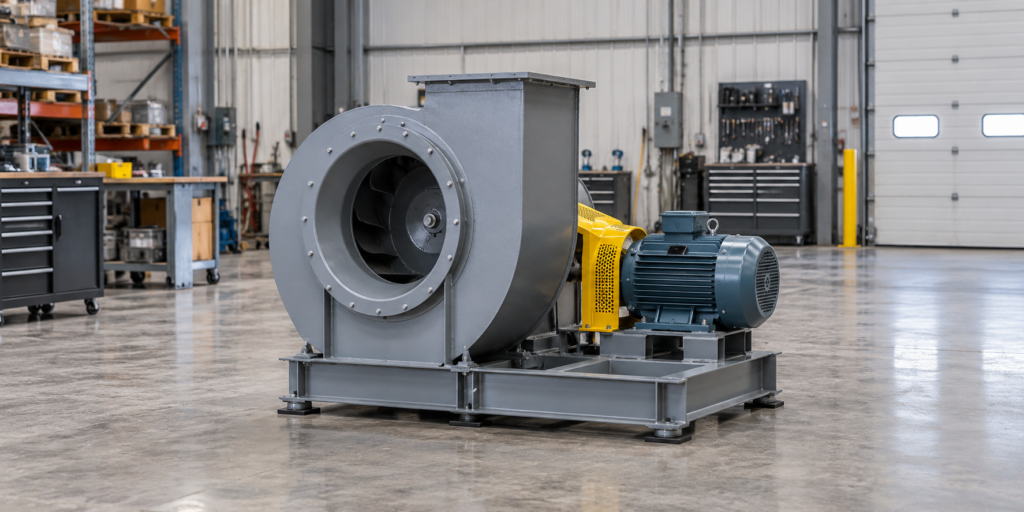
For a product reference, compare the duty and connection drawing for a 9-26 high-pressure centrifugal fan with the project requirements. It is an example in the site catalog, not a substitute for engineering selection.
6. Plan the changeover and commissioning
Before removing the old equipment, document its wiring, rotation, damper positions and operating readings. Agree on isolation, lifting and installation steps with the responsible site team. After installation, verify the direction of rotation, guards, fasteners, electrical connections and duct connections before startup. Check vibration, noise and operating readings against the project’s acceptance criteria, and record the final settings for future maintenance.
If the existing application uses another centrifugal fan arrangement, review the site’s Y9-38 centrifugal fan product page as a catalog reference. Confirm model-specific data and drawings with the supplier before treating any product as a replacement.
What information should you send with a replacement inquiry?
Provide the fan and motor nameplate photos, operating airflow and pressure, handled medium and temperature, rotation and discharge orientation, drive type, connection dimensions, available space and any drawings or commissioning records. Flag uncertain measurements clearly so they can be checked before an order is finalized.
Frequently asked questions
Can I replace a fan with one that has the same motor power?
Not based on motor power alone. The operating duty, speed, electrical supply, fan arrangement, rotation, connections and installation dimensions also need to be checked.
Can the existing ductwork stay in place?
Possibly, if the replacement’s inlet and outlet positions and dimensions match and the system duty remains suitable. Verify the drawings and measurements before ordering.
What if the existing fan has no drawings?
Collect clear photos, nameplate details, measured dimensions and operating information. Mark unknown values rather than guessing, then have the replacement arrangement reviewed before manufacture.
A careful replacement check starts with verified operating data and ends with a documented commissioning review. If any duty, electrical or mechanical detail is uncertain, resolve it with the responsible engineer and supplier before ordering.