
News
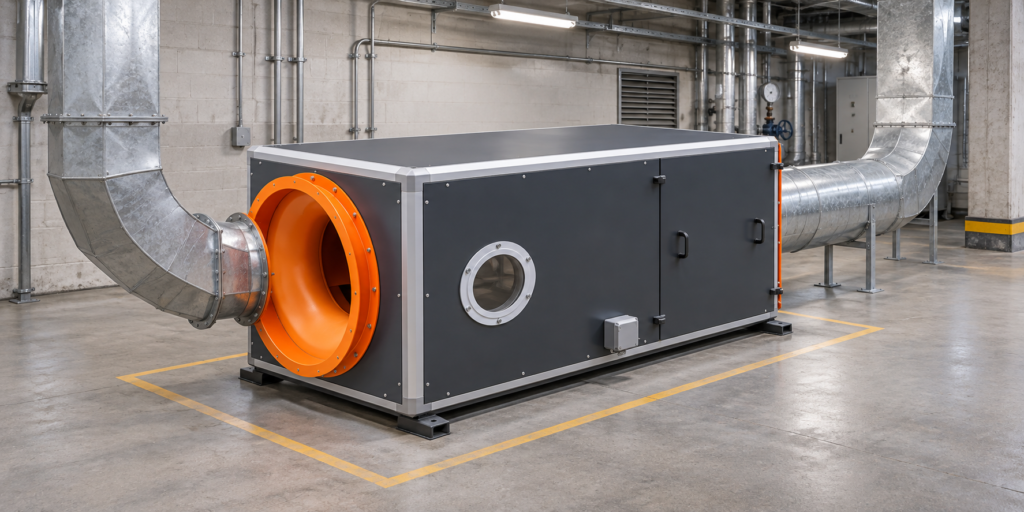
Choosing an APF air purification box fan starts with the air volume the system must deliver, then checks whether the fan can maintain that flow against the pressure losses in the filters, ductwork and connected equipment. The model table on the APF air purification box type forced draft fan page provides airflow and pressure ranges for several models. Use those figures as a starting point and confirm the required operating point for the complete installation.
1. Define the required airflow
Estimate the airflow needed by the room or process using the applicable project requirements. The required volume should reflect the intended air change or process duty, the occupied area, and any outdoor-air or recirculation arrangement. Avoid choosing a model from the largest airflow number alone: a system needs enough capacity at its actual operating pressure.
The APF product table lists volume ranges from 1,650–2,845 m³/h for model 3.6A through 9,624–17,285 m³/h for model 8.0A. These are published ranges, not a substitute for a duty-point selection. If the required airflow falls near a range boundary, ask the supplier to check the selection against the system resistance and fan curve.
2. Add up the system pressure losses
Filters, duct length, elbows, transitions, dampers, grilles and other components all affect the pressure the fan must overcome. Prepare a simple system sketch and list the components before selecting a model. Where filter loading changes during service, consider the clean and expected service pressure conditions in the design review.
Compare the required airflow with the pressure data for the same model. For example, the APF page lists model 5.0A at 2,991–4,731 m³/h and 482–174 Pa pressure, while model 6.0A is listed at 4,783–8,680 m³/h and 696–270 Pa. These ranges show why model size should be checked together with pressure, rather than by motor power or airflow alone.
3. Read the filtration information carefully
The product page describes the APF as a box-type forced-draft fan with staged filtration and lists a filtration-efficiency figure of 99.9% at 0.5 μm in its model table. Treat this as the published product information for the stated configuration. Confirm the exact filter stages, test basis, replacement elements and intended particle range with the supplier for the project; do not assume the figure applies to every installation or contaminant.
Also review the filter-box dimensions shown for the chosen model. Allow access to inspect and replace filters, and check that the cabinet can be brought into the mechanical room and connected to the planned duct route.
4. Check power, speed and installation constraints
Compare the listed motor power, voltage and rotation speed with the site electrical supply and control approach. The APF table includes models at 2,900 rpm and 1,450 rpm, with different airflow and pressure ranges. Electrical compatibility, noise expectations, vibration isolation, service clearance and safe access should be reviewed as part of the equipment schedule.
Before ordering, confirm the operating medium, mounting arrangement, inlet and outlet connection, available space, maintenance access and any project-specific requirements. If the installation uses additional duct components or filters, include them in the pressure calculation.
Quick APF selection checklist
- Set the required airflow for the application.
- Estimate total system pressure loss, including filters and duct fittings.
- Match airflow and pressure to one model’s published range.
- Confirm filter configuration, stated efficiency basis and replacement access.
- Verify dimensions, voltage, motor power, speed and connection layout.
- Request supplier confirmation of the selected operating point before purchase.
Frequently asked questions
Can I select an APF model using airflow alone?
No. Check airflow together with the pressure required by the complete system. A model that meets the volume target at a lower resistance may not deliver the same volume when filters and ductwork are included.
Does the listed 99.9% filtration figure apply to every application?
The product page lists 99.9% at 0.5 μm. Confirm the filter configuration and test basis for the specific order, and check that the stated particle size and filtration arrangement suit the application.
What information should I send when requesting a selection?
Provide the required airflow, estimated system pressure, duct layout, filter arrangement, site voltage, installation dimensions and operating conditions. Include any project requirements that affect maintenance or access.
For model details and the published APF table, see the APF product information.