
News
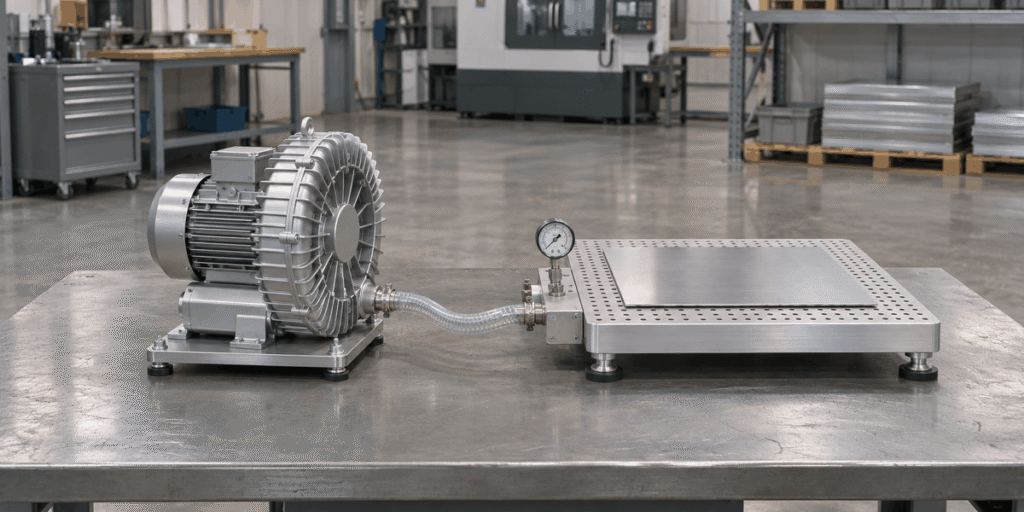
A ring blower for vacuum holding removes air through a fixture’s ports and sealed zones to hold a workpiece in place. The right model depends on the vacuum level required at the workpiece, the airflow needed to manage leakage, and the pressure losses in the hose and manifold. A single “maximum vacuum” value is not enough to select a blower.
Start with the workholding requirement
Describe the material and the operation first. Record the workpiece size, surface condition, weight, cutting or handling forces, and whether the material is porous. Then map the fixture’s active vacuum area, port layout, seals, and expected leakage. The ideal holding force relates to the pressure difference across the sealed area, but real fixtures lose holding capacity through leaks, uneven surfaces, and open zones. Have the fixture designer confirm the required safety margin for the operation.
Match vacuum and airflow at the operating point
Vacuum level and airflow work together. A tight fixture may need a different operating point from a porous sheet or a fixture with several open zones. Estimate the leakage that the blower must handle while maintaining the required vacuum at the workpiece. Include the hose length, internal diameter, bends, filters, valves, and manifold because each can affect system resistance.
The PXG ring blower product page lists vacuum-holding as a typical application and provides model-specific volume, pressure, and vacuum data. These values vary by model. Do not assume that the maximum listed vacuum and the maximum listed airflow occur at the same point. Ask the supplier for the performance curve or written confirmation of airflow at the required vacuum, with the proposed inlet and piping conditions.
Plan the fixture and air path together
Reduce avoidable leakage
Use the fixture layout and workpiece geometry to control which zones are active. Check gasket contact, unused ports, joints, and quick connections for leakage. For porous materials, provide the material type and exposed area when requesting a model review; the blower must be checked under the expected leak load, not only with a sealed inlet.
Check pipework and filtration
Keep the vacuum line appropriately sized and avoid unnecessary restrictions. If the process can draw dust, chips, or fibers into the line, discuss an inlet filter and its maintenance with the supplier. A loaded filter can change the system’s available airflow, so include it in the proposed arrangement rather than adding it after the blower has been selected.
Make vacuum visible to the operator
Consider where a gauge or suitable vacuum sensor should measure pressure: a reading near the blower may not match the pressure at a distant fixture. For multiple work zones, define how zones are isolated and how operators will recognize a loss of holding vacuum. The final control and safety arrangement should follow the machine builder’s risk assessment.
What to include in a quotation request
- Target vacuum at the fixture and the required airflow at that condition.
- Workpiece material, size, porosity, surface condition, and expected leakage.
- Fixture zones, port arrangement, hose dimensions, length, and fittings.
- Operating cycle, ambient conditions, power supply, and any dust or fiber exposure.
- Request for the model-specific curve, connection details, and service requirements.
Use the same operating conditions when comparing models. You can review the PXG type ring blower data and send the complete fixture information through the product quotation request for a model-specific review.
Frequently asked questions
Can I choose a ring blower by maximum vacuum alone?
No. Confirm the airflow available at the required vacuum and account for leakage and system resistance. The model curve and fixture conditions determine whether the operating point is suitable.
Does a porous workpiece change blower selection?
Yes. Porous material can increase air leakage through the fixture. Share the material and exposed area so the required airflow can be evaluated at the intended vacuum.
Is the vacuum measured at the blower the same as at the fixture?
Not necessarily. Pipework, filters, fittings, and leakage affect pressure along the system. Check the measurement point and verify vacuum at the fixture under operating conditions.