
Solutions
A reliable factory ventilation solution is essential for manufacturing workshops in Southeast Asia, where high temperatures, humidity, heat-generating equipment, and long production hours can make indoor air quality difficult to control. In this project case, POPULA provided an industrial ventilation plan combining axial fans, centrifugal fans, and fresh air supply to improve airflow inside a manufacturing workshop.
The project focused on removing accumulated heat, improving air exchange, and supporting a safer and more comfortable production environment. Instead of using only one fan type, the solution matched different ventilation equipment to different areas of the workshop.
Project Background
The customer operated a medium-sized manufacturing workshop in Southeast Asia. The building had a metal roof, several heat-producing machines, and limited natural ventilation. During the hot season, indoor temperatures increased quickly, especially in production zones far from doors and windows.
The customer needed a practical factory ventilation solution that could improve air movement without interrupting daily production. The system also needed to be easy to maintain, suitable for continuous operation, and flexible enough for future workshop expansion.
Customer Challenges
Before the project upgrade, the workshop faced several common ventilation problems. Hot air gathered near the roof, production areas had uneven airflow, and some corners had poor air circulation. Workers also reported that the indoor environment became uncomfortable during peak afternoon temperatures.
Main Problems on Site
- Heat buildup under the metal roof
- Insufficient fresh air supply in the production area
- Uneven airflow between different workshop zones
- Local exhaust demand near heat-generating equipment
- Limited installation space for large duct systems
- Need for reliable continuous ventilation
These conditions required more than simple wall exhaust. The system needed both general air exchange and targeted exhaust for specific working areas.
Site Conditions and Ventilation Requirements
The workshop layout included open production lines, storage areas, equipment zones, and loading access. Because the roof height was relatively high, hot air naturally moved upward and stayed near the upper area of the building. At the same time, some machines generated additional heat during continuous operation.
After reviewing the working conditions, POPULA engineers recommended a combined ventilation design. The main goal was to create a stable airflow path: bring in fresh air, guide air across the production area, remove hot air from upper zones, and extract local heat where necessary.
POPULA Factory Ventilation Solution
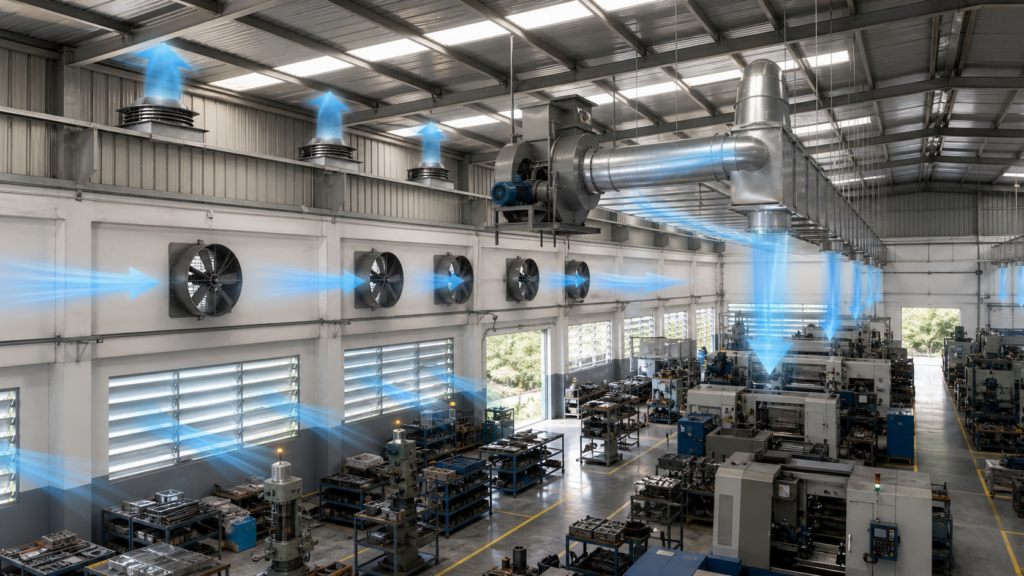
The final factory ventilation solution used a combination of axial fans, centrifugal fans, and fresh air components. Each product type played a different role in the system.
1. Axial Fans for General Workshop Exhaust
Wall-mounted axial fans were selected for large-volume air exchange. These fans were installed along the side walls to exhaust hot indoor air and support continuous airflow across the workshop.
Axial fans were suitable because the workshop required high airflow with relatively low resistance. Their compact structure also made installation easier, especially in areas where long ducts were not practical.
2. Centrifugal Fans for Local Exhaust Areas
For equipment zones with higher exhaust resistance, centrifugal fans were used to provide stronger pressure. These fans helped extract hot air from selected process areas and move it through ductwork to the outside.
Centrifugal fans were recommended because they can handle duct resistance, elbows, and local exhaust points more effectively than general axial fans.
3. Fresh Air Supply for Better Air Replacement
Exhaust alone is not enough for a balanced ventilation system. Fresh air supply points were arranged to help replace discharged air and reduce negative pressure inside the workshop.
By combining exhaust fans with fresh air intake, the workshop could maintain more stable airflow and avoid pulling unfiltered air from uncontrolled openings.
Installation Method
The installation was planned to reduce disruption to the customer’s production schedule. Wall-mounted axial fans were positioned in areas where hot air could be discharged directly. Centrifugal fans were connected to duct sections for local exhaust points near heat-generating equipment.
Fresh air openings were arranged according to airflow direction, production layout, and building structure. This helped create a clear ventilation path from fresh air intake to exhaust outlet.
Key Installation Considerations
- Fan positions matched the natural airflow direction of the workshop
- Exhaust points were placed near upper hot-air zones where practical
- Local exhaust was arranged close to heat-generating equipment
- Fresh air supply was balanced with exhaust volume
- Maintenance access was reserved for fan inspection and cleaning
Project Results
After installation, the workshop achieved better air movement and more stable ventilation. Hot air was removed more effectively, and the production area had improved air exchange. The customer also reported a more comfortable working environment during hot weather.
The combined system provided a practical balance between performance, installation cost, and maintainability. Instead of relying on one large fan type, the solution used different equipment where each fan performed best.
Observed Improvements
- Improved airflow across production areas
- Reduced heat accumulation near the roof
- Better fresh air replacement inside the workshop
- More effective local exhaust near equipment zones
- Improved comfort for workers during hot operating periods
- A scalable layout for future ventilation upgrades
Why a Combined Fan System Works Better
Many factory ventilation projects need more than one type of fan. Axial fans are excellent for large airflow and direct exhaust, while centrifugal fans are better for ducted exhaust and higher resistance areas. Fresh air supply helps make the whole system more balanced.
In this Southeast Asia workshop project, the combined system allowed each ventilation product to work in the right position. This made the factory ventilation solution more efficient and easier to manage in daily operation.
Recommended POPULA Products for Similar Projects
For manufacturing workshops, warehouses, and industrial buildings with similar ventilation needs, POPULA can recommend different fan types according to the project conditions.
- Industrial axial fans for wall exhaust and general ventilation
- Centrifugal fans for ducted exhaust and local extraction
- Fresh air ventilation systems for balanced air replacement
- Roof exhaust fans for upper hot-air removal
- Customized ventilation solutions based on airflow and pressure requirements
FAQ
What is the best factory ventilation solution for hot workshops?
The best solution depends on workshop size, heat source, airflow path, and installation conditions. Many hot workshops need a combination of exhaust fans, fresh air supply, and local extraction.
Are axial fans suitable for factory ventilation?
Yes. Axial fans are suitable for large airflow and low-resistance ventilation, especially for wall exhaust, roof exhaust, and general workshop air exchange.
When should a factory use centrifugal fans?
Centrifugal fans are recommended when the system includes ducts, elbows, filters, or local exhaust points that require higher pressure.
Can POPULA help with fan selection for overseas projects?
Yes. POPULA can review airflow requirements, workshop layout, pressure conditions, and installation details to recommend suitable industrial fan models.
Need a Factory Ventilation Solution?
If your workshop has heat buildup, poor airflow, or insufficient fresh air, POPULA can help design a suitable factory ventilation solution. Send us your workshop size, equipment layout, airflow requirement, and working conditions, and our team will recommend axial fans, centrifugal fans, or a combined ventilation system for your project.