
News
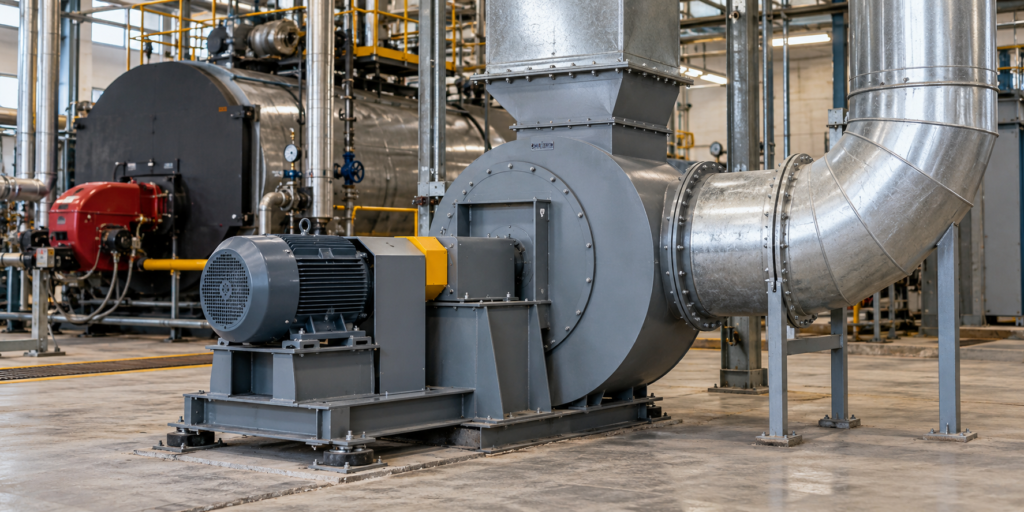
Boiler centrifugal fan selection starts with identifying the fan’s duty. A forced-draft fan supplies combustion air to the burner, while an induced-draft fan draws flue gas from the boiler and helps maintain the draft required by the system. After the duty is clear, the fan must be matched to the required airflow, pressure, gas conditions, and connected equipment.
This guide explains the main checks to make before selecting a boiler fan. The exact model and operating limits should be confirmed against the boiler design and the fan manufacturer’s current performance data.
Start with the fan’s role: forced draft or induced draft
A forced-draft (FD) fan is installed on the combustion-air side. It pushes air toward the burner. An induced-draft (ID) fan operates on the flue-gas side and pulls combustion products through the downstream path. Some boiler arrangements use both functions; the project design determines the required arrangement and control strategy.
This site’s Y9-38 boiler centrifugal fan page describes the model as an induced-draft fan for industrial boiler draft applications. The boiler fan range lists additional models. Use these site product pages to identify relevant model families, then confirm the required fan duty against the project’s operating conditions and current model data before comparing products.
1. Define the required airflow and pressure
Prepare the required volume flow and the pressure the fan must overcome at the intended operating condition. Include the design basis used by the boiler or process engineer. Airflow by itself is not enough: the fan must deliver the required flow while overcoming resistance from the connected system.
For an induced-draft installation, account for the complete flue-gas route and connected equipment. Ducts, bends, dampers, heat-recovery equipment, particulate collectors, and the stack can contribute pressure losses. For forced draft, include the combustion-air path and burner-side requirements. Use the project design data rather than estimating from motor power or boiler size alone.
2. Describe the gas at the fan inlet
Record the expected inlet temperature, gas composition or medium, moisture, dust or ash loading, and any corrosive constituents. These conditions can affect fan construction, materials, bearings, sealing, drive arrangement, and maintenance needs. Provide normal and maximum operating conditions if they differ.
Do not assume a general-purpose fan is suitable for a hot, dusty, or corrosive stream. Ask the supplier to confirm the exact configuration against the stated gas conditions and applicable project requirements.
3. Compare the model data at the required duty point
Review the manufacturer’s performance curve or selection data for the exact model and configuration. Check that the required airflow and pressure fall within the permitted operating range at the stated gas condition. Also confirm speed, motor power, voltage, frequency, installation arrangement, and any limits on continuous operation.
The Y9-38 product page lists model sizes with power, rotation speed, volume, and pressure data. Those table entries are model-specific reference data; they do not replace a project selection. Ask for confirmation of the selected operating point and configuration before ordering. The site also lists other boiler fan models, including the Y5-48 boiler centrifugal fan.
4. Coordinate the fan with the boiler controls
Boiler draft and combustion-air requirements are tied to the boiler’s controls and operating sequence. Confirm how the fan will be started, controlled, monitored, and protected; how dampers or other control devices interact with it; and what operating signals or alarms are required. Commissioning should verify performance under the approved operating conditions.
Changes to a boiler’s draft or combustion-air system should be reviewed by the responsible boiler or combustion professional. Do not change fan speed, damper positions, or control settings based only on a general article or a product table.
Boiler fan selection checklist
- Confirm whether the duty is forced draft, induced draft, or another specified arrangement.
- Provide the required airflow and pressure, including the design conditions.
- Share a system drawing showing ducts, dampers, burners, heat-recovery equipment, collectors, and the stack as applicable.
- State gas temperature, medium, moisture, dust or ash, and corrosive conditions.
- Confirm power supply, speed or control requirements, installation arrangement, and operating schedule.
- Ask the supplier to verify the selected model and operating point against current performance data.
For model information, browse POPULA’s boiler fan range. For a project review, send the boiler duty, airflow and pressure requirements, gas conditions, and system layout through the POPULA contact page.
Frequently asked questions
What is the difference between a forced-draft and an induced-draft boiler fan?
A forced-draft fan pushes combustion air toward the burner. An induced-draft fan draws flue gas from the boiler through the downstream gas path. The boiler design determines which duty is required.
Can I select a boiler fan using boiler capacity alone?
No. Boiler capacity alone does not define the fan operating point. Selection also depends on required airflow, system pressure losses, gas conditions, fan duty, and the approved control arrangement.
What information should I send when requesting a boiler fan selection?
Provide the fan duty, airflow, pressure, gas temperature and composition, dust or moisture conditions, system drawing, electrical supply, control requirements, and operating schedule.
Does a product table confirm the correct fan for my boiler?
A product table helps identify available model data, but the selected fan must be checked against the project’s required operating point and gas conditions. Request model-specific confirmation before ordering.