
Solutions
When planning an industrial ventilation system, one of the most common questions is: axial fan vs centrifugal fan — which one should I choose? Both fan types are widely used in factories, warehouses, commercial buildings, HVAC systems, smoke exhaust systems, and process ventilation. As an industrial fan manufacturer, POPULA helps customers compare fan types according to real airflow conditions, system pressure, and installation requirements.
Choosing the wrong fan may lead to insufficient airflow, excessive noise, high energy consumption, poor exhaust performance, or unstable system pressure. This guide explains the main differences between axial fans and centrifugal fans, helping you make a better selection for your industrial ventilation project.
What Is an Axial Fan?
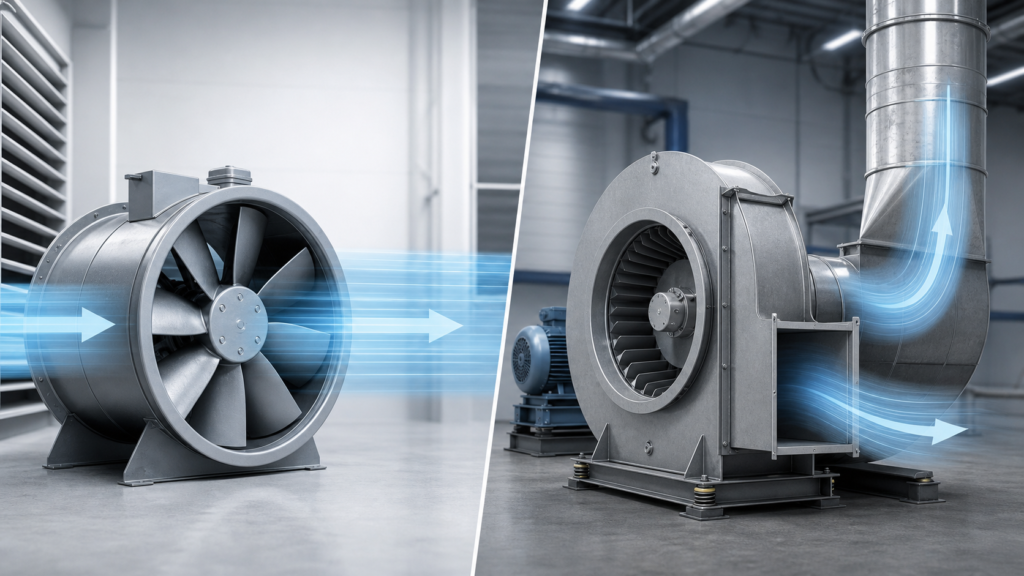
An axial fan moves air in a straight direction along the fan axis. The airflow enters and exits the fan in the same line, similar to how a propeller works. Axial fans are commonly used when a large volume of air needs to be moved with relatively low pressure resistance.
In industrial applications, axial fans are often installed on walls, roofs, ducts, production workshops, warehouses, greenhouses, underground parking areas, and general ventilation systems. They are suitable for direct exhaust, fresh air supply, heat removal, and air circulation.
Typical Features of Axial Fans
- Large airflow capacity
- Lower pressure compared with centrifugal fans
- Compact structure and easy installation
- Suitable for direct ventilation or short duct systems
- Commonly used for factory ventilation and cooling
What Is a Centrifugal Fan?
A centrifugal fan changes the direction of airflow. Air enters the fan wheel near the center and is discharged outward by centrifugal force. Compared with axial fans, centrifugal fans can generate higher pressure, making them suitable for ducted systems and applications with higher resistance.
Centrifugal fans are often used in HVAC systems, dust collection, fume extraction, filtration systems, air handling units, kitchen exhaust systems, boiler ventilation, and industrial process exhaust. They are especially useful when air must pass through long ducts, filters, silencers, dampers, or elbows.
Typical Features of Centrifugal Fans
- Higher static pressure capability
- Stable airflow in ducted systems
- Suitable for medium and high resistance applications
- Can handle filtration, dust collection, and process exhaust
- Available in different impeller designs for various working conditions
Axial Fan vs Centrifugal Fan: Key Differences
The main difference between an axial fan and a centrifugal fan is how they move air and how much pressure they can provide. Axial fans are usually selected for high airflow and low pressure. Centrifugal fans are selected for higher pressure and higher system resistance.
1. Airflow Direction
An axial fan moves air straight through the fan. This makes it suitable for wall-mounted exhaust, roof ventilation, tunnel ventilation, and open-space air circulation.
A centrifugal fan changes airflow direction inside the fan housing. This structure allows the fan to build higher pressure, which is useful for duct systems and equipment ventilation.
2. Air Volume and Pressure
Axial fans are strong in air volume. If your project requires moving a large amount of air across a short distance, an axial fan is often the practical choice.
Centrifugal fans are stronger in pressure. If your system includes long ducts, filters, bends, dampers, or other resistance, a centrifugal fan is usually more suitable.
3. Installation Conditions
Axial fans are often easier to install because of their compact design. They can be mounted on walls, windows, ducts, roofs, or ventilation openings.
Centrifugal fans usually require more installation space because of the fan casing, outlet direction, base frame, and duct connection. However, they provide better performance in more complex ventilation systems.
4. Noise and Efficiency
Noise level depends on fan speed, blade design, airflow volume, pressure, and installation conditions. In general, axial fans can be efficient for low-resistance ventilation, while centrifugal fans can be more efficient in high-resistance duct systems.
For both fan types, correct selection is more important than simply comparing the product type. A properly selected fan can reduce noise, improve airflow stability, and lower operating costs.
When Should You Choose an Axial Fan?
You should consider an axial fan when your ventilation system requires large airflow with low pressure resistance. This is common in general factory ventilation, workshop cooling, warehouse exhaust, fresh air supply, and direct wall or roof ventilation.
Axial fans are also a good choice when the installation space is limited and the air path is relatively simple. For example, if hot air needs to be exhausted directly from a production workshop to the outside, an axial fan can be an efficient and economical solution.
Common Applications of Axial Fans
- Factory wall exhaust
- Workshop heat removal
- Warehouse air circulation
- Roof ventilation
- Fresh air supply
- Short duct ventilation
- Parking garage ventilation
When Should You Choose a Centrifugal Fan?
You should consider a centrifugal fan when the system has higher resistance or requires stable pressure. This often happens when air must move through ducts, filters, dust collectors, silencers, dampers, or multiple elbows.
Centrifugal fans are also commonly used for industrial exhaust systems where the air contains dust, fumes, heat, or process gases. Different impeller types and materials can be selected according to the working condition.
Common Applications of Centrifugal Fans
- Ducted HVAC systems
- Dust collection systems
- Fume extraction
- Filtration systems
- Commercial kitchen exhaust
- Boiler induced draft or forced draft
- Industrial process ventilation
How to Select the Right Industrial Ventilation Fan
Before choosing between an axial fan and a centrifugal fan, it is important to understand the actual working conditions. A fan should not be selected only by motor power or fan diameter. The correct selection depends on airflow, pressure, medium, temperature, installation method, noise requirements, and system resistance.
Key Information Needed for Fan Selection
- Required airflow volume
- Static pressure or total pressure
- Duct length and duct layout
- Number of elbows, filters, dampers, or silencers
- Air temperature and humidity
- Whether the air contains dust, smoke, oil mist, or corrosive gas
- Voltage and frequency
- Indoor or outdoor installation
- Noise control requirements
If these conditions are not clear, POPULA engineers can help review the project requirements and recommend a suitable fan model. Providing airflow, pressure, layout drawings, and working environment information will make the selection more accurate.
Axial Fan vs Centrifugal Fan: Quick Selection Summary
For simple ventilation with large airflow and low resistance, an axial fan is often the better choice. For ducted systems, filtration systems, dust extraction, or higher pressure requirements, a centrifugal fan is usually more suitable.
In many industrial projects, axial fans and centrifugal fans can also be used together. For example, axial fans may provide general workshop ventilation, while centrifugal fans handle local exhaust, dust collection, or process ventilation.
FAQ
Which is better, axial fan or centrifugal fan?
Neither is always better. An axial fan is better for large airflow and low resistance ventilation, while a centrifugal fan is better for higher pressure and ducted systems.
Can axial fans be used with ducts?
Yes, axial fans can be used with short and low-resistance ducts. For long ducts or systems with filters and many elbows, a centrifugal fan is usually more suitable.
Why do centrifugal fans provide higher pressure?
Centrifugal fans use an impeller and casing design that changes airflow direction and generates higher static pressure, making them suitable for systems with higher resistance.
What information is needed before selecting an industrial fan?
The most important information includes airflow, pressure, duct layout, air temperature, working environment, installation method, voltage, and noise requirements.
Need Help Choosing the Right Fan?
POPULA provides industrial axial fans, centrifugal fans, smoke exhaust fans, cabinet fans, and fresh air ventilation solutions for factories, commercial buildings, HVAC systems, and industrial projects.
If you are not sure whether your project needs an axial fan or a centrifugal fan, contact POPULA with your airflow, pressure, working condition, and installation requirements. Our team can help you choose a reliable and efficient industrial ventilation fan solution.