
News
Belt-drive vs direct-drive centrifugal fans are not a one-size-fits-all choice. The decision depends on the required operating point, available space, maintenance access, control plan, and the configuration offered for the specific fan model. Confirm these details with the product data and supplier before ordering.
How the two drive arrangements work
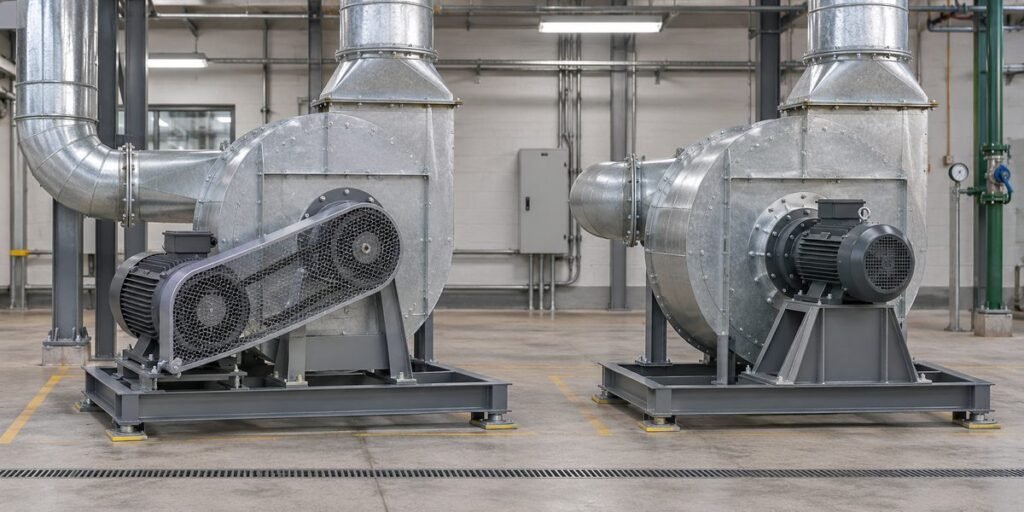
A direct-drive arrangement connects the motor to the fan shaft through a direct coupling or a motor-mounted arrangement. A belt-drive arrangement transfers rotation from the motor to the fan shaft through pulleys and belts. The actual construction varies by model, so confirm the drawing and drive details for the unit being quoted.
What buyers should compare
Speed and duty-point matching
With a belt transmission, pulley selection can establish a mechanical speed ratio. Any change to a specified ratio must be approved for the fan and motor and checked against the fan curve, motor limits, and mechanical design. A direct-drive unit has a fixed mechanical relationship between motor and fan; variable-speed control, where available, is a separate electrical and application decision. In either case, compare the required airflow and pressure at the actual system operating point rather than choosing by motor power alone.
Maintenance access
A belt-drive installation needs access to inspect belt condition, tension, alignment, and guards according to the manufacturer’s instructions. A direct-drive arrangement removes belt components from the drive train, but it still needs the specified inspection of the motor, bearings, coupling or mounting, fasteners, and fan wheel. Consider whether technicians can reach service points safely after the fan is installed.
Space, foundation, and environment
Compare the complete footprint, shaft and motor position, service clearance, base, and connection layout shown on the approved drawing. Dust, temperature, moisture, and corrosive conditions can affect motor protection, materials, and maintenance intervals. Provide these operating conditions when requesting a quotation; do not assume a standard configuration suits every environment.
Five checks to include in a quotation request
- State the required airflow, pressure, operating hours, and whether the fan handles clean air or another medium.
- Provide the power supply, control method, and any speed-adjustment requirement.
- Share the installation space, connection dimensions, mounting arrangement, and maintenance clearances.
- Describe temperature, dust, moisture, and any corrosion concerns.
- Ask the supplier to confirm the offered drive arrangement, motor details, drawing, fan curve, and service requirements for the selected model.
Use the same duty and installation information when comparing alternatives. For examples of product-specific data, review the Y9-38 boiler centrifugal fan and the XQ high-pressure centrifugal fan pages, then confirm the configuration for your own application.
Frequently asked questions
Is a belt-drive fan always easier to adjust?
A belt transmission provides a mechanical speed ratio, but pulley changes are not a substitute for engineering review. The resulting operating point and motor load must remain suitable for the fan and system.
Does direct drive mean maintenance-free operation?
No. It removes belt inspection from the service routine, but the motor, fan wheel, bearings, fasteners, guards, and installation still require checks specified for that model.
Which arrangement should I request?
Send the duty point, environment, power supply, control needs, and installation drawing to the supplier. Ask them to confirm which drive arrangement is available and suitable for the exact model.
Compare the full service task
Look beyond the drive label. Record whether the fan will run continuously, how often planned service can be scheduled, whether replacement belts or coupling parts are available, and what isolation steps technicians must follow. If several fans are being specified, standardizing a configuration may simplify training and spares, but check each fan’s duty and installation before applying one arrangement to every unit. Ask the supplier to state the approved drive, rotation, motor details, and operating range on the quotation and drawing.