
News
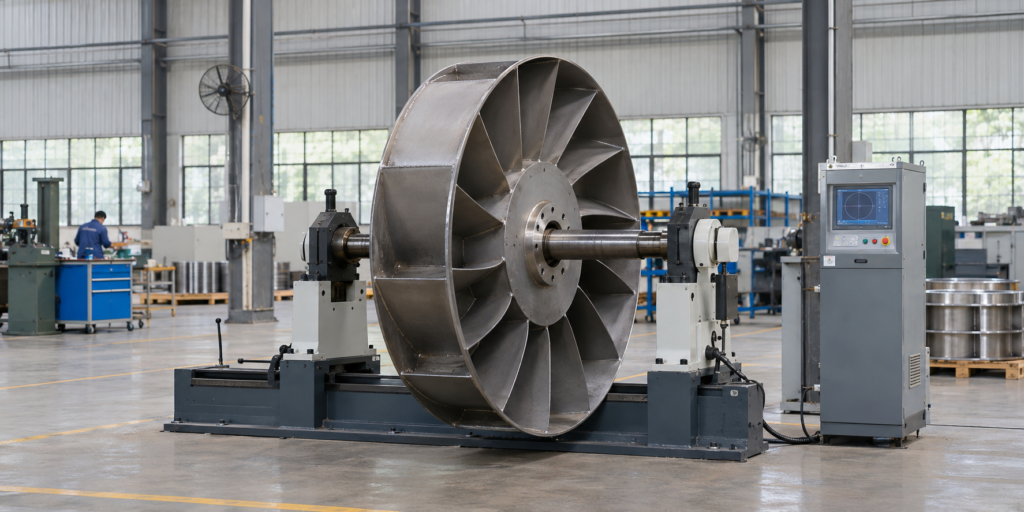
Industrial fan impeller balancing is one of the manufacturing steps buyers can ask about when specifying equipment. It addresses the distribution of mass in a rotating impeller so the assembly can run more smoothly. It does not replace correct fan selection, installation, or commissioning checks.
What impeller balancing checks
A fan impeller rotates at operating speed. If its mass is unevenly distributed around the axis, rotation can create an unbalanced force. Dynamic balancing is used to assess and correct this condition on the rotating component or assembly being tested. The exact procedure and acceptance criteria depend on the fan design, configuration, and order requirements; there is no single value that should be assumed for every industrial fan.
On its manufacturing overview, indblower.com lists impeller balancing and motor assembly among its production capabilities, alongside airflow, pressure, vibration, and noise testing. These are related quality steps, but they answer different questions: balancing concerns the rotating assembly, while performance testing checks how the assembled fan behaves under stated test conditions.
Why it matters when ordering an industrial fan
Industrial centrifugal, axial, boiler, and high-pressure fans can have different impeller designs and operating duties. A balancing record is useful only when its scope is clear. Buyers should be able to connect the record to the fan series, model, configuration, and component covered by the order. A general statement that a product is “balanced” does not show which assembly was checked or what criteria applied.
Five questions to ask the supplier
- Which component was balanced? Confirm whether the record applies to the impeller alone, a rotor assembly, or another defined rotating component.
- At what production stage was it checked? Ask whether balancing took place before or after the relevant assembly steps, and whether later changes could affect the result.
- Can the record be matched to the order? Look for identifying details such as the model, configuration, date, or other information that ties the result to the equipment being supplied.
- Which acceptance criteria apply? Request the criteria used for the specific fan and order. Do not assume a universal tolerance across different sizes, speeds, or designs.
- What checks are separate from balancing? Ask how the supplier documents assembly, motor checks, airflow and pressure testing, and any vibration or noise measurements required for the project.
Balancing is one part of a complete quality review
A balanced impeller cannot compensate for every cause of vibration in service. Installation alignment, support stiffness, foundation condition, duct forces, operating point, and maintenance condition can also affect how a fan runs. For that reason, factory balancing should be reviewed as one manufacturing control, while installation and commissioning are handled separately.
When comparing equipment, first identify the relevant series in the indblower.com centrifugal fan catalog or the appropriate category in the full product catalog. For a project-specific balancing record or technical document request, contact the indblower.com technical team and provide the model and order configuration.
Frequently asked questions
Does impeller balancing guarantee a vibration-free fan?
No. Balancing addresses mass distribution in a rotating component. Installation, supports, duct connections, operation, and other factors can still influence vibration.
Should I expect the same balancing criteria for every fan model?
No. Ask the supplier which criteria apply to the specific design, size, speed, and order configuration.
Is a balancing record the same as a fan performance test report?
No. A balancing record concerns the rotating component or assembly. A performance report covers measurements such as airflow or pressure under stated test conditions. Request the records that match your project requirements.
What should I send when requesting balancing documentation?
Provide the fan series and model, ordered configuration, and any project documentation requirements. This helps the supplier identify the relevant production record.