
News
Centrifugal Fan vs Axial Fan: Which Is Better for Industrial Ventilation?
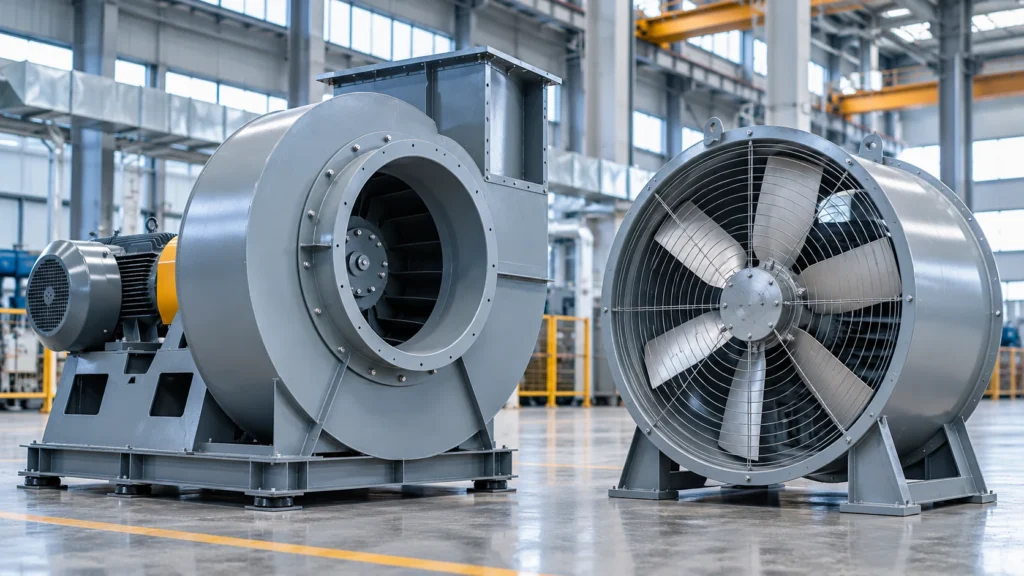
Choosing between a centrifugal fan and an axial fan is an important decision in industrial ventilation system design. Both types move air, but they differ in airflow direction, pressure capability, installation requirements, and suitable applications.
The short answer: Axial fans are often preferred for high-volume airflow through relatively low-resistance systems, while centrifugal fans are commonly selected when air must travel through ductwork, filters, or other components that create higher pressure losses.
However, neither design is automatically better. The right choice depends on the required airflow, system pressure, operating environment, and fan performance curve.
In this guide, POPULA FAN explains the differences between centrifugal and axial fans and how industrial buyers can choose the appropriate equipment for their projects.
1. What Is a Centrifugal Fan?
A centrifugal fan is an air-moving device that uses a rotating impeller to draw air into its inlet and redirect it outward through the impeller.
In many common designs, air enters axially and exits through a housing that directs the airflow toward an outlet.
Centrifugal fans are widely used in industrial systems where airflow must overcome resistance from ducts, filters, dampers, and other equipment.
Typical applications include:
- Industrial dust collection and extraction
- Factory exhaust and process ventilation
- Boiler air supply and induced draft systems
- Commercial kitchen exhaust systems
- HVAC air handling and duct ventilation
- Industrial equipment and production-line ventilation
Centrifugal fans are available in different configurations, including forward-curved, backward-curved, and radial-blade designs. Each configuration has its own operating characteristics.
POPULA FAN offers several centrifugal fan series for industrial applications, including the 4-72 general-purpose centrifugal fan and C6-46 dust extraction centrifugal fan.
2. What Is an Axial Fan?
An axial fan moves air primarily in a direction parallel to its rotating shaft.
Its impeller blades generate airflow through a cylindrical housing or another suitable mounting arrangement.
Axial fans are commonly used where large volumes of air must be moved with relatively low system resistance.
Typical applications include:
- Factory and workshop ventilation
- Wall-mounted industrial exhaust
- Warehouse ventilation
- Equipment cooling
- Roof ventilation
- Agricultural and greenhouse ventilation
- Suitable ducted air supply systems
One example is the POPULA FAN SF(G) axial fan series, which is listed for general ventilation, air supply, roof ventilation, and selected industrial applications.
Axial fans can also be designed for higher-pressure applications, so final selection should always be based on the specific model’s performance data rather than fan type alone.
3. Centrifugal Fan vs Axial Fan: Key Differences
The following comparison summarizes the main characteristics of these two industrial fan types.
| Feature | Centrifugal Fan | Axial Fan |
|---|---|---|
| Airflow direction | Air is redirected through the impeller | Air moves primarily along the shaft |
| Typical pressure capability | Often suitable for higher-resistance systems | Often suitable for lower-resistance systems |
| Airflow applications | Ducted exhaust, process ventilation, filtration | General ventilation, cooling, air exchange |
| Installation | Often requires more space around the housing and connections | Can offer a compact, inline arrangement |
| Dust handling | Specialized models available for particle-laden air | Depends on model and dust conditions |
| Energy efficiency | Depends on design and operating point | Depends on design and operating point |
| Noise | Depends on speed, design, installation, and operating point | Depends on speed, design, installation, and operating point |
| Maintenance | Depends on bearings, drive, impeller, and operating environment | Depends on bearings, motor, blades, and operating environment |
The most important difference is not simply the amount of air each fan can move. It is how effectively the fan delivers the required airflow against the resistance of the complete ventilation system.
4. Which Fan Is Better for High Airflow?
Both centrifugal and axial fans can provide substantial airflow, depending on their size, speed, and design.
For applications such as warehouse ventilation or general workshop air exchange, axial fans are often a practical option.
They can move large volumes of air through relatively direct airflow paths without requiring extensive ductwork.
For example, an industrial workshop with wall-mounted exhaust openings may benefit from axial fans that remove accumulated heat and support fresh air exchange.
However, if the same facility requires air to pass through long ducts, filters, or multiple elbows, a centrifugal fan may be more appropriate.
The correct comparison must be made at the required operating pressure, not at free-air airflow ratings alone.
5. Which Fan Is Better for High Static Pressure?
Static pressure is one of the most important considerations in industrial ventilation design.
As air passes through ducts, filters, elbows, and other components, the system creates resistance.
The fan must overcome this resistance while maintaining the required airflow.
Centrifugal fans are commonly used for higher-resistance applications because many centrifugal designs can provide the pressure required by industrial duct systems.
For example, a dust collection system may include:
- Multiple extraction hoods
- Long duct sections
- Several elbows and transitions
- Dust separation equipment
- Filter assemblies
These components create pressure losses that must be considered during fan selection.
An appropriately selected centrifugal fan can be suitable for such applications.
However, some specially designed axial fans can also produce significant pressure. Engineers should compare actual performance curves before making a final decision.
6. Which Fan Is More Energy Efficient?
There is no universal rule that centrifugal fans are more efficient than axial fans, or vice versa.
Fan efficiency depends on the impeller design, motor, operating speed, system resistance, and selected operating point.
A fan that is highly efficient under one set of conditions may perform poorly in a different ventilation system.
For example, selecting a large fan and then restricting airflow with a damper may increase unnecessary energy consumption.
Similarly, selecting a fan that cannot overcome the required pressure may result in inadequate ventilation.
To improve energy performance, industrial buyers should:
- Determine the required airflow.
- Calculate the system pressure losses.
- Review manufacturer performance curves.
- Compare fan efficiency near the required operating point.
- Consider suitable motor and speed-control options.
A properly matched fan system is generally more valuable than choosing equipment based on a single efficiency claim.
7. Industrial Applications: When Should You Choose Each Fan?
Factory and Workshop Ventilation
Axial fans are often suitable for general air exchange, heat removal, and wall-mounted exhaust in factories and workshops.
Centrifugal fans may be preferred when the ventilation system includes long ducts, filters, or localized extraction equipment.
Industrial Dust Collection
Dust collection systems often require centrifugal fans capable of overcoming resistance from extraction ducts and filtration equipment.
For suitable dust extraction applications, POPULA FAN offers the C6-46 centrifugal fan series, designed for conveying air containing materials such as wood scraps and fine fibers within specified operating conditions.
The fan model must be selected according to dust characteristics, operating temperature, pressure requirements, and relevant safety considerations.
Warehouse Ventilation
Large warehouses may use axial fans for general ventilation and heat removal where airflow paths are relatively direct.
If a warehouse ventilation system includes extensive ductwork, centrifugal or appropriately selected duct fans may be required.
Boiler and Industrial Process Ventilation
Industrial boilers and process systems often require fans that can maintain airflow against substantial system resistance.
Specialized centrifugal fans are commonly used for forced draft and induced draft applications.
The fan must be selected for the relevant temperature, gas composition, pressure, and operating requirements.
Equipment Cooling
Axial fans are frequently used for equipment cooling when high airflow and compact installation are important.
Centrifugal blowers may be used where cooling air must pass through restrictive passages or connected ducts.
8. POPULA FAN Industrial Centrifugal and Axial Fan Solutions
POPULA FAN is an industrial ventilation equipment manufacturer based in Foshan, Guangdong, China.
Established in 1996, the company supplies centrifugal fans, axial fans, exhaust fans, and other industrial ventilation equipment for a range of applications.
Its product portfolio includes several fan types for different airflow and pressure requirements.
POPULA 4-72 Centrifugal Fan
The 4-72 series is part of POPULA FAN’s general-purpose centrifugal fan range.
It can be considered for suitable industrial ventilation and air-handling applications where a centrifugal configuration is required.
POPULA C6-46 Dust Extraction Centrifugal Fan
The C6-46 series is designed for applications involving air containing dust, wood scraps, or fine fibers within its specified operating limits.
It is an option to evaluate for compatible industrial dust extraction systems.
POPULA SF(G) Axial Fan
The SF(G) series is intended for applications including general ventilation, air supply, roof ventilation, and selected industrial environments.
It is an option for projects where an axial airflow configuration meets the required system conditions.
For each series, the final selection should be based on technical specifications, installation requirements, and the project’s actual operating point.
9. How to Choose Between a Centrifugal Fan and an Axial Fan
Before purchasing an industrial ventilation fan, prepare the following information:
Required Airflow
Specify the required airflow in m³/h or CFM.
System Pressure
Determine the pressure needed to overcome ductwork, filters, dampers, and other system components.
Operating Temperature
Identify the normal and maximum temperatures of the air or gas being conveyed.
Air or Gas Characteristics
Confirm whether the medium contains dust, moisture, corrosive substances, or other materials requiring special consideration.
Installation Conditions
Review available space, inlet and outlet connections, mounting arrangements, and maintenance access.
Electrical Requirements
Specify voltage, frequency, motor requirements, and available control systems.
Operating Schedule
Indicate whether the fan will operate continuously, intermittently, or under variable-load conditions.
With this information, the supplier can review suitable models and performance data for the project.
10. Frequently Asked Questions
Is a centrifugal fan better than an axial fan?
Not necessarily. Centrifugal fans are commonly preferred for higher-resistance duct systems, while axial fans are often suitable for large-volume ventilation with relatively low resistance. The best choice depends on the operating point and application.
Can an axial fan be used with ductwork?
Yes. Certain axial fans are designed for ducted installations. However, duct resistance must be checked against the specific fan’s pressure capability and performance curve.
Which fan is suitable for industrial dust collection?
Specialized centrifugal fans are frequently used in industrial dust collection systems because these systems often have substantial pressure losses. The fan must also be compatible with the dust and gas characteristics, including any combustible-dust hazards.
Are centrifugal fans quieter than axial fans?
Not always. Noise depends on fan design, rotational speed, airflow conditions, installation, and operating point. Manufacturer sound data should be reviewed for an accurate comparison.
Which fan consumes less electricity?
Electricity consumption depends on the required airflow, system pressure, fan efficiency, motor efficiency, and operating schedule. Neither fan type is automatically more economical in every application.
What information should I provide when requesting an industrial fan quotation?
Provide the required airflow, pressure, operating temperature, gas characteristics, installation layout, electrical requirements, and application details. These help the supplier recommend a suitable fan model.
Conclusion: Which Industrial Fan Should You Choose?
The choice between a centrifugal fan and an axial fan depends on the ventilation system’s actual requirements.
Choose an axial fan when the application mainly requires high-volume air exchange through a relatively low-resistance airflow path.
Consider a centrifugal fan when the system includes significant duct resistance, filtration equipment, localized extraction, or industrial process ventilation requirements.
For reliable performance, always compare the required operating point with the manufacturer’s fan performance data.
Looking for the Right Industrial Fan?
POPULA FAN supplies industrial centrifugal fans, axial fans, and related ventilation equipment for factories, contractors, and industrial projects.
Whether your application involves general factory ventilation, dust extraction, air supply, or process exhaust, our team can help you review suitable fan options.
Contact POPULA FAN to request product specifications, performance curves, and a quotation for your industrial ventilation project.
Website: https://www.chinapopula.com/
Email: info@populablower.com