
News
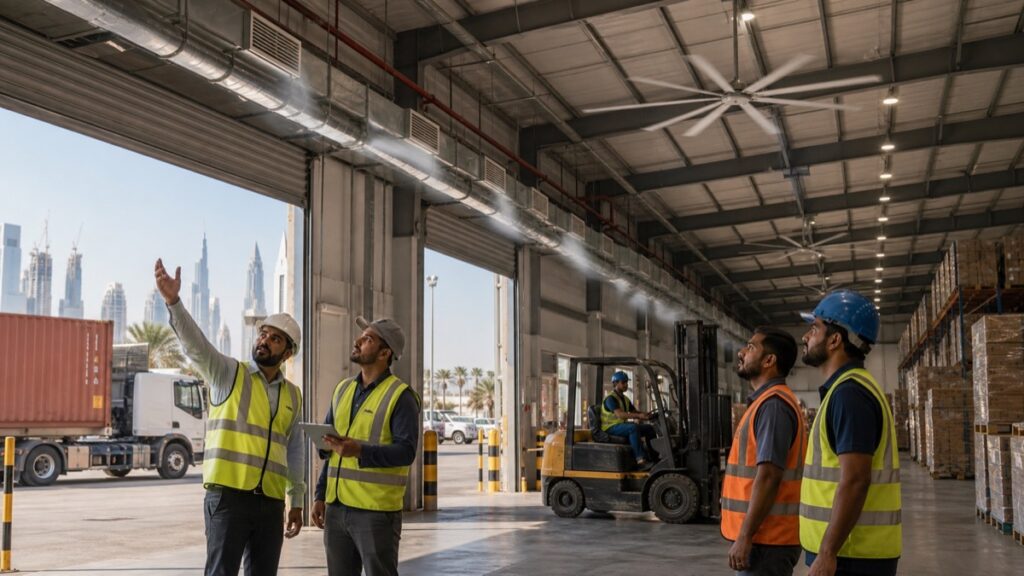
POPULA warehouse ventilation fan demand is increasing as logistics facilities and light industrial warehouses in the Middle East, South Asia, and Southeast Asia prepare for longer hot-season operations. In many warehouse projects, ventilation is no longer treated as a simple comfort accessory. It is becoming part of daily operating reliability, especially for loading bays, high-roof storage zones, and mixed warehouse-production areas.
Warehouses in hot climates often face a practical airflow challenge. Large doors may remain open for trucks and forklifts, but open doors do not always create controlled air exchange. Heat can still accumulate under the roof, warm air can remain around loading docks, and workers may experience uneven comfort between storage aisles, packing areas, and dispatch zones.
For these projects, POPULA focuses on matching the fan type and airflow layout to the actual warehouse structure instead of recommending a single generic product. The goal is to support steadier air movement, reduce stagnant heat, and help facilities plan ventilation before peak operating pressure arrives.
Why POPULA warehouse ventilation fan demand is rising in hot-climate logistics sites
Across fast-growing logistics hubs, warehouses are handling more frequent loading, packing, temporary storage, and light assembly tasks inside the same building. This mixed use makes airflow planning more important. A warehouse may have open docks, tall pallet racks, packing tables, office partitions, and equipment areas in one space. Each zone has a different ventilation need.
During hot months, the roof space can trap warm air, while loading doors bring in outdoor heat. Forklifts and frequent truck movement can also create localized warm zones near dispatch areas. If the only ventilation source is a small wall exhaust fan or a few portable fans, air movement may be strong in one corner but weak in the main working area.
That is why more warehouse owners are evaluating industrial fans earlier in the project stage. A suitable ventilation layout can help connect ceiling-level circulation, wall exhaust, and local airflow routes so the whole facility works as a system.
Common ventilation issues in warehouse and loading-bay operations
Hot-climate warehouses usually report several repeated issues before upgrading the ventilation system:
- Warm air collecting under high roofs and mezzanine areas
- Stagnant air near loading docks during busy dispatch hours
- Uneven airflow between storage aisles, packing zones, and door areas
- Limited air exchange when doors are opened and closed throughout the day
- Need for continuous-duty fans that can handle long operating schedules
These problems are especially common in warehouses serving e-commerce, food packaging, building materials, spare parts, and general industrial distribution. The ventilation design must support people, goods, and operating equipment at the same time.
How POPULA fan selection supports warehouse ventilation planning
For high-roof warehouse spaces, large-area circulation is often a first step. Industrial ceiling fans can move air slowly across a wide area, helping reduce stagnant zones and supporting more even airflow across the working floor. This is useful where workers move between pallets, packing stations, and loading doors.
For areas that need directed exhaust, wall-mounted or duct-connected exhaust fans may be added near loading bays, equipment zones, or enclosed sections. In some warehouse layouts, centrifugal fans are also considered when air must move through ducts, bends, or longer discharge paths.
The right choice depends on building height, door position, rack layout, heat sources, operating hours, and whether the facility needs general circulation, direct exhaust, or both. POPULA helps project teams review these conditions so fan selection can match the real site rather than only the floor area.
Ventilation upgrades are becoming part of warehouse project planning
For logistics developers and warehouse operators, better ventilation can support a more stable working environment, especially during seasonal demand peaks. It can also help reduce the need for temporary fixes such as portable fans placed randomly around the loading zone.
As more facilities in the Middle East, South Asia, and Southeast Asia expand warehouse capacity, demand for practical fan systems is expected to remain steady. For hot-climate warehouse projects, early ventilation planning can make later installation easier and help the site avoid airflow problems after operations begin.
For warehouse, logistics, and light industrial ventilation projects, POPULA can provide fan selection support based on building layout, airflow path, working zones, and installation conditions. POPULA fan solutions can be adapted for general circulation, loading-bay exhaust, and mixed warehouse ventilation requirements.