
News
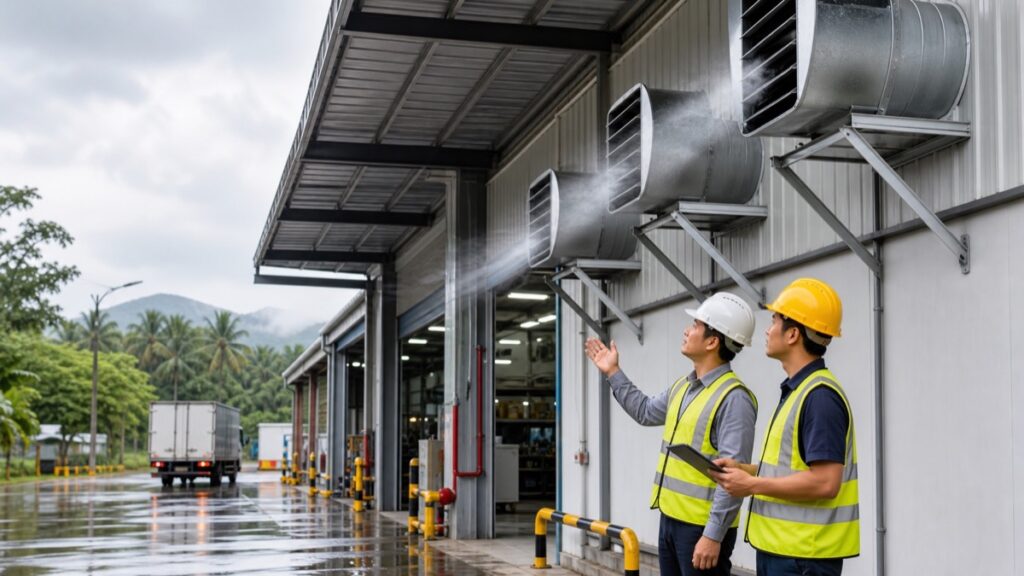
POPULA industrial ventilation fan solutions are receiving more attention from factories in South Asia and Southeast Asia as rainy-season humidity, heat buildup, and indoor air quality become practical concerns for production sites. In many workshops, the challenge is no longer only high temperature. Moist air, condensation, odor, and slow air exchange can also affect worker comfort, equipment reliability, and daily operating efficiency.
For manufacturers in markets such as Bangladesh, Vietnam, Thailand, Malaysia, Indonesia, and the Philippines, humid weather can make ventilation planning more urgent. Textile workshops, food processing plants, packaging facilities, warehouses, and light manufacturing sites often operate with long production hours, large indoor spaces, and mixed heat sources from machinery, people, lighting, and logistics activity.
As a result, more project owners are looking beyond simple wall openings or small exhaust units. They want industrial ventilation systems that can move enough air, support continuous operation, and fit real factory layouts. This is where POPULA helps factories evaluate airflow, installation conditions, and suitable fan types before purchase.
Why POPULA industrial ventilation fan demand is growing in humid factory regions
In a humid-climate factory, poor air movement can create several connected problems. Warm air may stay trapped near production lines, moisture can accumulate around walls or ceilings, and odors may spread slowly through the workshop. In some facilities, storage areas and loading zones also face stagnant air after rain, especially when doors remain partially closed for safety or production control.
These conditions are common in fast-growing industrial zones across South Asia and Southeast Asia. Many factories are expanding production capacity, adding new lines, or upgrading older buildings. When a workshop grows but the original ventilation system remains unchanged, indoor airflow can become uneven. Some areas may feel acceptable, while other areas become hot, damp, or difficult to work in for long shifts.
A well-planned industrial ventilation fan system can help remove warm and moisture-heavy air, introduce fresher airflow, and reduce stagnant zones. For humid regions, the goal is not simply to install more fans. The more important step is to match fan type, airflow direction, duct resistance, installation position, and operating environment.
Typical factory ventilation problems during rainy season
During rainy months, industrial buildings often face different ventilation pressure than during dry weather. Production managers may report that the workshop feels heavier, smells remain longer, or finished goods areas require better air circulation. In facilities with heat-generating machinery, humidity can make workers feel hotter even when the actual temperature has not changed dramatically.
Common site issues include:
- Insufficient exhaust from enclosed production areas
- Slow removal of warm, humid, or odor-containing air
- Uneven airflow between production lines, storage zones, and loading areas
- High resistance when air must pass through ducts, filters, elbows, or long exhaust paths
- Concerns about fan durability in wet, dusty, or continuously operating environments
For these situations, a single fan selection is rarely enough. Project teams often need to compare axial fans, centrifugal fans, cabinet fans, roof exhaust units, and duct-connected systems based on the actual building layout.
How POPULA fan solutions support humid-climate workshops
For factories that need direct exhaust or large-volume air movement, an axial fan can be a practical option. Axial fans are commonly used where the air path is relatively short and the system requires high airflow with moderate resistance. For wall exhaust, workshop ventilation, and general air exchange, industrial axial fan options can help improve air movement across wide spaces.
When the ventilation system includes ductwork, filters, bends, or longer exhaust routes, centrifugal fans may be more suitable. Centrifugal fan systems are often selected for higher-pressure applications where airflow must overcome resistance. In humid factories, this matters because air may need to be collected from specific production points and discharged through a controlled route instead of being released directly through a nearby opening.
For many light industrial buildings, wall-mounted or duct-connected exhaust fans can also provide a simpler upgrade path. Products such as JS type exhaust fans are commonly considered for workshops, warehouses, and general ventilation areas where reliable air exchange is needed.
Ventilation planning is becoming part of factory reliability
Industrial ventilation is increasingly treated as part of overall factory reliability, not only as a comfort issue. Better air exchange can support safer working conditions, reduce stagnant indoor zones, and help create a more stable environment for production and storage. In humid climates, these benefits are especially important because moisture and heat often appear together.
POPULA recommends that project teams prepare basic site information before selecting fans, including workshop size, ceiling height, heat sources, air path, duct length, installation position, power conditions, and the expected operating schedule. With this information, engineers can recommend whether an axial fan, centrifugal fan, exhaust fan, or combined ventilation layout is more appropriate.
As more factories in South Asia and Southeast Asia continue to expand, demand for industrial ventilation solutions is expected to remain steady. For humid-climate projects, choosing the right fan system early can help reduce later modification costs and support a more comfortable, reliable production environment.