
News
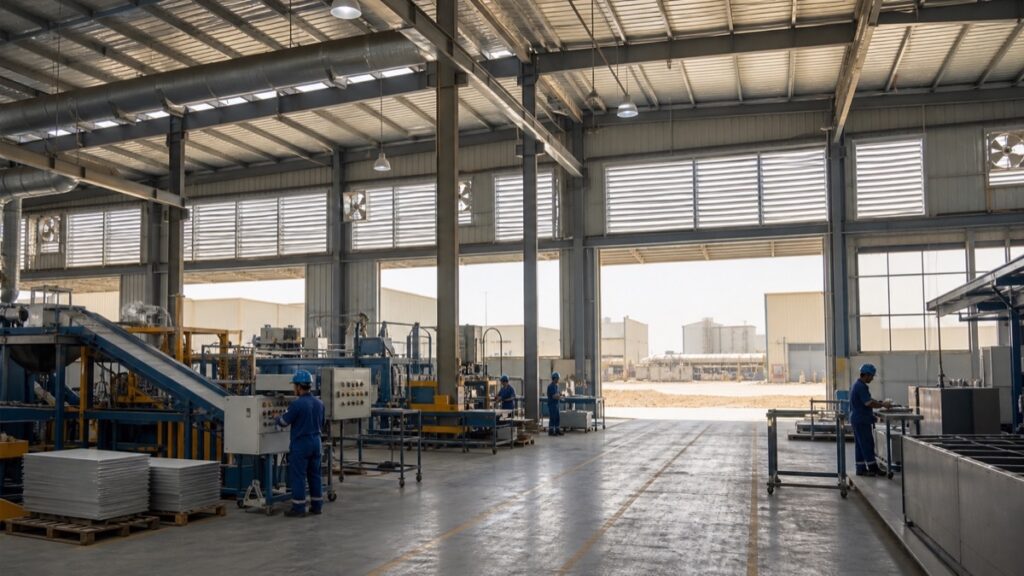
Hot-climate industrial ventilation is becoming a more important engineering and procurement priority across the Middle East, South Asia, and Southeast Asia. Factories in these markets must often manage high outdoor temperatures together with humidity, dust, solar heat gain, long production schedules, and limited natural airflow. As a result, buyers are paying closer attention to how ventilation equipment performs under actual site conditions rather than comparing nominal airflow alone.
The trend comes as extreme heat remains prominent across the wider region. The World Meteorological Organization’s recently released State of the Climate in Asia 2025 identifies dangerous heat, drought, dust storms, and other extreme conditions as major regional risks. For industrial facilities, this reinforces the need to review ventilation systems as part of operational resilience, worker environment management, and equipment heat control.
Hot-Climate Industrial Ventilation Is More Than Moving Air
A fan that performs adequately in a mild environment may face different operating demands in a hot factory. High ambient temperature can affect motors, bearings, electrical components, lubricants, and control equipment. At the same time, production machinery, furnaces, compressors, lighting, workers, and solar radiation through roofs and walls add heat inside the building.
Simply installing more circulation fans does not guarantee effective heat removal. Circulation fans move indoor air but may continue to recirculate heat if the building does not have a defined exhaust route and sufficient replacement air. A complete plan needs to identify where fresh air enters, how it travels through occupied and production zones, and where hot or contaminated air leaves.
Different Regional Conditions Require Different Designs
The term “hot climate” covers several distinct operating environments.
Middle East: Heat, Dust, and High Ambient Temperature
Industrial projects in the Gulf and other parts of the Middle East may experience high daytime temperatures, strong solar gain, airborne dust, and outdoor installation conditions. Fans, motors, control panels, louvers, coatings, and electrical enclosures should be evaluated for the actual ambient temperature and exposure.
Dust can collect on guards, filters, motors, impellers, and heat-transfer surfaces. Maintenance access and cleaning intervals therefore matter as much as initial fan capacity. Outdoor equipment may also require weather protection without restricting inlet or discharge airflow.
South Asia: Heat, Humidity, and Dense Production Layouts
Factories in India, Pakistan, Bangladesh, and nearby markets often combine seasonal heat with humid conditions, high occupancy, and densely arranged production equipment. Garment manufacturing, food processing, plastics, metalworking, and warehouse operations can each create different internal heat and contaminant loads.
In these buildings, the ventilation layout should avoid short-circuit airflow between nearby inlets and exhaust points. Replacement air needs to pass through the working area rather than bypassing it. Processes that generate dust, fumes, moisture, or heat at a specific source may also need local extraction instead of relying only on general room ventilation.
Southeast Asia: Humidity, Corrosion, and Continuous Operation
High humidity, heavy rainfall, coastal air, and long operating hours can influence ventilation equipment in Southeast Asian factories. Condensation and corrosion risk should be considered when selecting materials, coatings, motors, bearings, and installation positions.
Where factories operate continuously, reliability and maintenance planning become critical. Multiple fans or standby capacity may be appropriate when an interruption would stop production or affect product quality. The correct arrangement depends on the process and consequences of fan failure.
Buyers Are Asking for More Complete Fan Selection Data
Industrial buyers increasingly recognize that diameter and motor power are not enough for reliable fan selection. A useful technical enquiry should include:
- required airflow;
- static or total pressure;
- indoor and outdoor design temperatures;
- air-stream temperature and composition;
- dust, humidity, oil, corrosive substances, or other contaminants;
- duct dimensions, filters, bends, dampers, and terminal equipment;
- installation space and orientation;
- voltage, frequency, and control method;
- daily operating hours and required redundancy.
These details allow engineers to select a fan around the actual duty point. Oversizing may increase power consumption, noise, and control difficulties, while undersizing can leave the system unable to overcome duct resistance or remove the required heat and contaminants.
Axial and Centrifugal Fans Serve Different Roles
Axial fans are commonly used for high-volume, relatively low-pressure duties such as wall exhaust, roof ventilation, air supply, and general workshop air exchange. Centrifugal fans are generally better suited to systems with ducts, filters, collectors, hoods, or other components that create higher resistance.
Mixed-flow and cabinet fans can address applications where installation space, pressure, sound, and duct configuration require a different balance. The equipment type should follow the system requirement rather than a preference for one fan design.
General ventilation and local exhaust must also be treated separately. A factory may use axial fans to remove accumulated heat while using a dedicated centrifugal extraction system for welding fumes, dust, kitchen smoke, or process emissions. Fire smoke exhaust remains a safety-critical application that requires equipment and controls selected according to applicable project codes.
Efficiency and Lifecycle Cost Are Becoming Procurement Priorities
Fans in industrial facilities may operate for many hours every day, making energy use an important part of lifecycle cost. The International Energy Agency’s Energy Efficiency 2025 industry analysis highlights motor-system upgrades and variable-speed drives as important industrial efficiency measures.
Variable-speed control can reduce unnecessary full-speed operation when ventilation demand changes, but it must be matched to the fan, motor, process, minimum safe speed, and control logic. Efficient equipment cannot compensate for an incorrectly sized fan, a blocked filter, poor duct design, or inadequate maintenance.
Buyers are therefore looking beyond purchase price to consider fan curves, motor efficiency, operating point, control options, cleanability, spare parts, and technical support.
Maintenance Planning Protects Performance in Harsh Environments
Hot, dusty, or humid conditions can accelerate performance loss when equipment is not inspected regularly. A maintenance plan should include checks of impeller cleanliness, bearing condition, lubrication, motor current, vibration, belt tension where applicable, filters, louvers, flexible connections, and duct leakage.
Recording baseline current, airflow, pressure, vibration, and temperature after commissioning gives maintenance teams a useful reference. Changes over time can reveal filter blockage, buildup, mechanical wear, or changes in system resistance before they cause a major interruption.
POPULA Supports Application-Based Ventilation Selection
POPULA supports industrial ventilation projects with axial fans, centrifugal fans, mixed-flow fans, cabinet fans, fire smoke exhaust equipment, and application-based selection assistance. Buyers can provide workshop dimensions, airflow and pressure requirements, operating temperature, duct layout, contaminants, power supply, and destination country for technical review.
The goal is not to recommend one standard fan for every hot-climate project. It is to match the equipment and ventilation arrangement to the actual building, process, environment, and maintenance capability.
As factories across the Middle East and Asia review their resilience to heat, dust, humidity, and long operating schedules, hot-climate industrial ventilation is likely to remain an important part of new construction and facility upgrade planning.