
Solutions
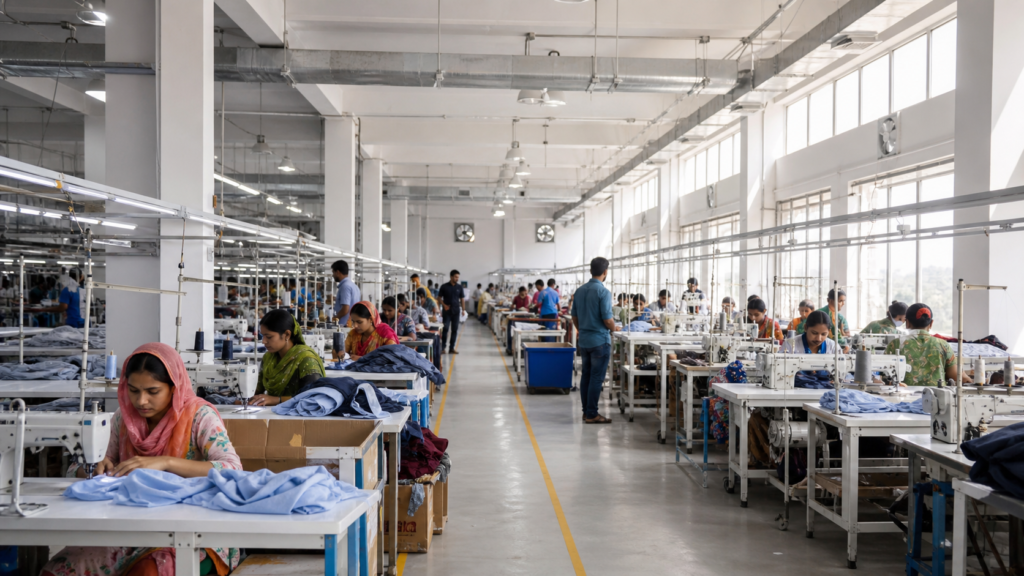
This textile factory ventilation solution addresses a familiar set of operating conditions in a garment manufacturing workshop in Dhaka, Bangladesh: heat released by production equipment, dense workstation layouts, humid seasonal air, limited cross-ventilation, and lightweight lint generated during fabric handling. The client identity and numerical site measurements are not disclosed, so the following project profile focuses on the engineering approach, equipment functions, and qualitative operating improvements.
The workshop produces finished garments through fabric preparation, sewing, inspection, and packing. Long production rows and a high number of occupied workstations make consistent air movement important. Before the ventilation review, the factory relied mainly on scattered circulation fans. These moved air locally but did not create a controlled route for hot indoor air to leave the building or for outdoor air to enter.
Textile Factory Ventilation Solution: Site Problems in Dhaka
The site team identified three connected problems rather than one simple shortage of fans.
Heat Accumulation Across the Production Floor
Heat from sewing motors, lighting, workers, ironing areas, and the building envelope accumulated during operating hours. Circulation fans provided temporary relief near individual stations, but they recirculated the same warm air. Areas farther from windows and external walls remained noticeably less comfortable.
Uncontrolled Fresh-Air Paths
Exhaust openings and air inlets were not arranged as one system. Air could take a short path between a nearby window and an exhaust point without sweeping through the occupied production zone. Other areas received little replacement air. This created uneven airflow across long rows of workstations.
Lint and Fine Textile Particles
Fabric cutting, trimming, handling, and sewing can release lightweight lint. General ventilation can dilute airborne contaminants, but it should not be treated as a substitute for local capture at concentrated sources. Moving more air without controlling the airflow direction may simply distribute lint to a wider area.
The POPULA Ventilation Strategy
POPULA organized the proposed improvement around two separate air-management functions: plant-wide heat removal and source-focused lint extraction. Keeping these functions separate is important because clean or lightly contaminated ventilation air and fiber-laden extraction air require different equipment arrangements and maintenance procedures.
1. Establishing a Cross-Workshop Air-Exchange Route
JS-II square negative-pressure fans were selected as the main exhaust concept for suitable external wall positions. Instead of placing exhaust units wherever space was available, the layout placed the extraction side away from planned fresh-air entry points. This creates a defined air path through the occupied production area.
Fan quantity and size must be calculated from the workshop volume, heat load, required air-change rate, inlet free area, operating schedule, and acceptable indoor pressure. The article deliberately does not provide a universal air-change figure because garment factories vary significantly in ceiling height, workstation density, process heat, and building construction.
2. Supplying Air to Low-Movement Zones
Where the building arrangement could not provide sufficient natural replacement air, SF series axial fans were considered for controlled fresh-air supply or airflow support. Their role was not to blow directly at workers at excessive velocity. Instead, supply positions were planned to distribute replacement air into areas that previously experienced weak circulation.
Supply and exhaust capacity should be balanced carefully. Excessive exhaust without adequate inlet area can increase negative pressure, reduce actual fan airflow, make doors difficult to operate, and draw unfiltered air through unintended openings. Excessive mechanical supply can push lint toward adjacent rooms. Commissioning therefore includes checking airflow direction at doors, aisles, production rows, and process boundaries.
3. Separating Lint Capture from General Ventilation
Concentrated lint sources require local capture hoods or extraction points positioned close to where particles are released. These points can connect to a dedicated duct and collection system. A centrifugal fan may be used to overcome the resistance of hoods, ducts, bends, filters, and collectors, but the fan cannot be selected by airflow alone.
A 4-72 centrifugal fan can be considered only when the actual air stream, dust concentration, temperature, and material characteristics fall within the model’s permitted operating conditions. Textile fibers may be combustible and can accumulate inside ducts or impellers. For that reason, the collector arrangement, anti-static measures, cleaning access, motor position, fire protection, and applicable local safety requirements must be reviewed before confirming equipment.
The filter or separator should normally capture lint before it reaches downstream equipment where required by the system design. Inspection doors and cleanable duct sections are also important because a system that performs well when new can lose airflow as lint accumulates.
Installation and Commissioning Priorities
The ventilation layout was developed to work around production rather than interrupt it. Wall openings, electrical supply, structural support, weather protection, noise transmission, and maintenance access all need review before installation. Fans installed above occupied or circulation areas require secure mounting and appropriate guards.
During commissioning, the project team should verify more than whether each fan rotates correctly. Practical checks include:
- confirming motor direction and operating current;
- checking vibration, abnormal noise, and mounting stability;
- observing airflow direction across the main production aisles;
- checking whether fresh air reaches previously stagnant zones;
- testing pressure loss across lint filters and collectors;
- confirming that extracted air does not discharge near fresh-air inlets;
- recording a clean-system baseline for future maintenance comparison.
Operational Effect of the Ventilation Improvement
After the airflow route was reorganized, the intended operating effect was a more consistent movement of replacement air through the production floor rather than isolated pockets of recirculation. Hot indoor air could be removed at defined exhaust points, while fresh air was directed toward occupied and previously stagnant areas.
The separated lint-extraction concept also reduced reliance on general room airflow to manage particles near concentrated sources. This helps keep the main ventilation system focused on heat and air exchange while allowing the dust-control equipment to be inspected and maintained according to its actual loading.
No specific temperature reduction, particle-removal percentage, energy-saving figure, or productivity increase is claimed without verified site measurements. For a completed installation, these results should be documented through before-and-after readings taken under comparable production and weather conditions.
Why the Same Design Cannot Be Copied to Every Textile Factory
A textile factory ventilation solution must reflect the actual process. A sewing workshop, dyeing plant, spinning mill, fabric warehouse, and ironing area can have very different heat, humidity, lint, chemical, and fire-safety requirements. Even two garment workshops in Dhaka may require different fan quantities because of their floor area, ceiling height, production density, inlet restrictions, and surrounding buildings.
Before recommending a final configuration, POPULA needs the workshop dimensions, layout, number of workers, main heat sources, operating hours, existing openings, target airflow, duct arrangement, and details of any lint or process contaminants. Photos and drawings help engineers identify likely short-circuit airflow paths and maintenance constraints.
By separating general heat removal from source-focused extraction, the proposed system provides a practical framework for improving garment workshop ventilation without overstating what a fan alone can achieve. Correct selection, safe dust handling, balanced air paths, and routine maintenance remain essential to long-term performance.