
News
Energy-efficient industrial fans are receiving greater attention as manufacturers look for practical ways to control electricity costs, improve equipment reliability, and prepare for stricter efficiency expectations. For factories operating ventilation, cooling, dust extraction, smoke control, or process-air systems for long hours, fan selection is increasingly being evaluated as part of the total operating cost rather than only the initial purchase price.
The trend is supported by a broader focus on industrial motor-system efficiency. The International Energy Agency identifies upgrades to motors and equipment such as fans, pumps, and compressors, together with variable-speed drives for variable-load applications, as important measures for improving industrial energy performance. At the same time, new European ecodesign requirements for industrial fans are scheduled to apply from July 24, 2026, bringing stricter performance and product-information expectations for covered equipment.
Why Energy-Efficient Industrial Fans Are Moving Up the Procurement Agenda
Ventilation fans can operate for thousands of hours each year. A fan that is oversized, poorly matched to the duct system, or controlled by inefficient throttling methods may consume unnecessary power throughout its service life. This means a small design decision made during procurement can influence operating expenses for years.
Factories are therefore asking more detailed questions before placing an order:
- What airflow and static pressure are actually required at the duty point?
- How does the fan perform when production demand changes?
- Can fan speed be adjusted instead of wasting pressure across dampers?
- Is the impeller suitable for the dust, temperature, humidity, or fumes in the air stream?
- How easy will the fan be to inspect, clean, balance, and repair?
These questions shift the discussion from nominal motor power to whole-system performance. A high-efficiency component cannot deliver its full benefit if the fan is selected far from its best operating range or installed in a duct layout with excessive resistance.
Correct Fan Selection Remains the First Efficiency Step
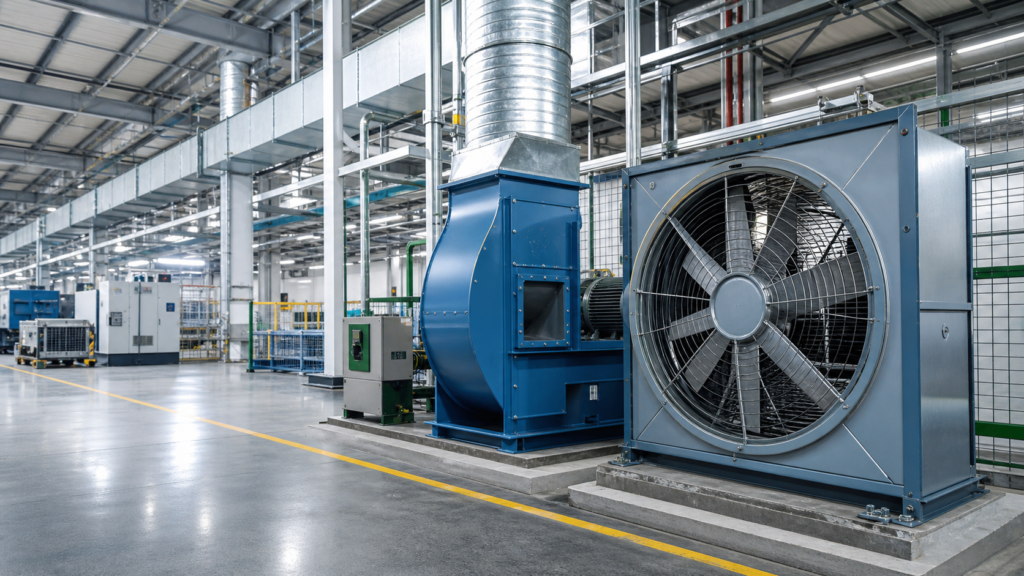
Axial and centrifugal fans serve different system requirements. Axial fans are commonly selected for high-volume, relatively low-pressure applications such as direct workshop exhaust, wall ventilation, and general air exchange. Centrifugal fans are better suited to systems that must overcome filters, collectors, long ducts, bends, hoods, or other sources of static pressure.
Choosing between these fan types based only on diameter or motor rating can lead to poor results. Engineers need the target airflow, total system resistance, operating temperature, air composition, installation space, duty cycle, and acceptable noise level. Selecting the fan around a realistic duty point helps avoid both inadequate ventilation and unnecessary power consumption.
POPULA supports project selection across axial fans, centrifugal fans, cabinet fans, mixed-flow fans, and specialized industrial exhaust equipment. By reviewing the application before recommending a model, the engineering team can match the fan structure to the actual airflow and pressure requirements.
Variable-Speed Control Supports Changing Production Loads
Many factory ventilation systems do not require maximum airflow at all times. Production lines may run in shifts, heat loads may change with the season, and dust or fume generation can vary by process. In these situations, variable-speed control allows fan output to follow actual demand more closely.
This approach can reduce unnecessary full-speed operation while improving process control. However, a variable-frequency drive should be selected and configured with the motor, fan curve, minimum safe speed, cooling requirements, and control logic in mind. It is an engineering tool rather than a universal add-on.
Maintenance Protects Long-Term Fan Efficiency
Even a correctly selected fan can lose performance when dust accumulates on the impeller, belts loosen, bearings deteriorate, filters become blocked, or ducts begin to leak. These conditions increase resistance, disturb airflow, and may force the system to operate longer to achieve the required result.
A practical maintenance plan should include routine checks of:
- impeller cleanliness and balance;
- bearing temperature, noise, and lubrication;
- belt tension and alignment where belt drives are used;
- motor current and vibration;
- filters, dampers, flexible connections, and duct leakage;
- airflow or pressure at critical points in the system.
Maintenance data can also reveal when a fan is operating outside its intended range. Repeated overload, unstable airflow, excessive noise, or frequent bearing problems may indicate that the system resistance or fan selection should be reviewed.
Efficiency Requirements Are Becoming More Specific
The European Commission states that the updated ecodesign framework covers industrial fans driven by motors with input power from 125 W to 500 kW and adds requirements related to performance at different loads and speeds, product information, repairability, and spare parts. For international buyers, this reinforces the importance of requesting clear technical data and confirming the standards applicable in the destination market.
The change also reflects a wider procurement trend: industrial buyers increasingly expect suppliers to discuss efficiency, maintainability, and lifecycle support alongside airflow and pressure. A durable fan that can be serviced properly and operated near its intended duty point provides a stronger foundation for long-term cost control.
Planning an Industrial Fan Upgrade
Before replacing an existing fan, factories should collect operating information rather than simply ordering the same motor power again. Useful details include current airflow, static pressure, motor current, operating hours, duct layout, process conditions, and the reason for the upgrade. Photos, drawings, filter specifications, and information about future production changes can further improve selection accuracy.
For new projects, early coordination between the equipment supplier, duct designer, contractor, and facility team helps prevent oversizing and avoidable pressure loss. POPULA can review project conditions and recommend an appropriate industrial fan configuration for factory exhaust, HVAC, cooling, dust extraction, smoke control, and process ventilation applications.
As operating costs and efficiency requirements receive more attention, energy-efficient industrial fans will continue to be evaluated as part of an integrated ventilation system. The strongest results come from combining suitable fan technology with accurate sizing, intelligent control, efficient duct design, and consistent maintenance.