
Solutions
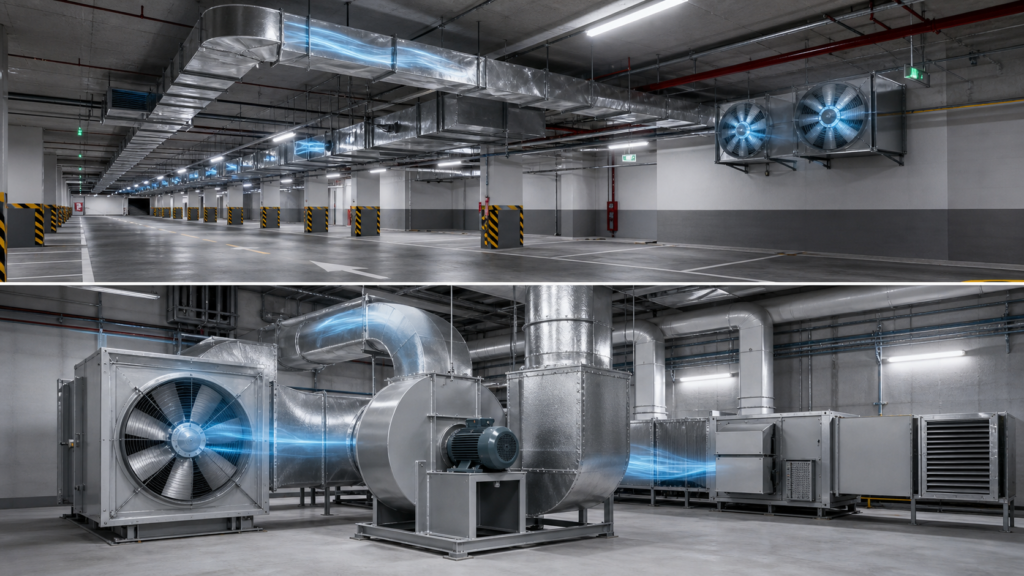
A reliable fire smoke exhaust fan solution is an important part of smoke control and emergency ventilation design for commercial buildings, underground parking areas, high-rise projects, and public facilities. In this project case, POPULA supported a commercial building ventilation project with fire smoke exhaust fans, cabinet centrifugal fans, axial smoke exhaust fans, and pressurization ventilation equipment.
The goal of the project was to provide a practical fan selection plan for smoke exhaust, air movement, and emergency ventilation areas. The system needed to match duct resistance, installation space, airflow requirements, and building safety design conditions.
Project Background
The project was a commercial building development with underground parking areas, equipment rooms, public corridors, and service zones. Because the building included enclosed spaces and ducted ventilation routes, the smoke exhaust system required fans with stable airflow and suitable pressure performance.
The customer needed a fan supplier that could provide multiple product types for different smoke control areas. Instead of using only one general fan model, the project required a combination of equipment for smoke exhaust, ducted ventilation, and pressurization air supply.
Customer Requirements
Before product selection, the customer provided basic project information including airflow requirements, duct layout, installation position, power supply, and application area. The main requirement was to select fans that could support emergency ventilation and smoke exhaust functions in different parts of the building.
Main Requirements
- Smoke exhaust fans for underground parking areas
- Ducted centrifugal fans for mechanical ventilation rooms
- Axial smoke exhaust fans for high-airflow exhaust sections
- Pressurization ventilation support for stairwells or protected areas
- Stable performance under duct resistance
- Convenient installation and maintenance access
Site Conditions and Selection Challenges
Commercial building projects often include long duct runs, elbows, dampers, silencers, and limited equipment room space. These factors can increase system resistance and make fan selection more complex.
For underground parking areas, the ventilation system may need to support both daily exhaust and emergency smoke exhaust requirements according to the project design. For stairwell or corridor areas, positive pressure air supply may also be considered to help maintain protected evacuation routes.
Because of these different working conditions, POPULA recommended selecting fan models according to the function of each system section instead of applying one fan type to the whole project.
POPULA Fire Smoke Exhaust Fan Solution
The final fire smoke exhaust fan solution combined several types of industrial ventilation equipment. Each fan type was selected based on airflow, pressure, installation method, and application zone.
1. HTF Fire Smoke Exhaust Fans
HTF fire smoke exhaust fans were recommended for major smoke exhaust sections where high airflow and reliable emergency ventilation performance were required. These fans are commonly used in commercial buildings, underground parking areas, tunnels, and other smoke control projects.
For this project, HTF fire smoke exhaust fans were considered for main exhaust routes connected to smoke exhaust ducts and outlet shafts.
2. Axial Smoke Exhaust Fans
Axial smoke exhaust fans were selected for areas requiring large airflow and relatively direct air discharge. Their compact structure makes them suitable for certain duct sections, wall openings, or equipment zones where space is limited.
In commercial building projects, axial smoke exhaust fans can help move large air volumes efficiently when the system resistance is suitable for axial fan operation.
3. Cabinet Centrifugal Fans
Cabinet centrifugal fans were used for ducted ventilation areas where stable pressure was needed. Compared with axial fans, centrifugal fans can handle higher duct resistance and are suitable for mechanical ventilation rooms, HVAC exhaust, and pressurization air supply systems.
The cabinet design also supports cleaner installation in commercial building equipment rooms and can help reduce exposed moving parts in service areas.
4. Pressurization Ventilation Support
Positive pressure air supply is often used in stairwells, antechambers, or protected evacuation areas depending on the building design. For this type of application, fan selection must consider airflow volume, pressure, duct resistance, and control requirements.
POPULA can recommend suitable fan models according to the pressurization system design and installation conditions.
Installation Considerations
For fire smoke exhaust and emergency ventilation projects, installation planning is just as important as product selection. Fan location, duct connection, vibration control, maintenance space, electrical access, and air outlet design can all affect system performance.
Key Installation Points
- Match fan direction with the designed airflow path
- Reserve sufficient maintenance and inspection space
- Use suitable duct connection and support structures
- Consider vibration isolation for equipment room installations
- Check damper, duct, and outlet resistance before final selection
- Coordinate fan control logic with the project fire safety design
Project Results
By combining different fan types, the project achieved a more practical smoke exhaust and emergency ventilation layout. Main exhaust areas were supported by fire smoke exhaust fans, ducted sections were supported by centrifugal fans, and high-airflow areas could use axial smoke exhaust fans where suitable.
The customer received a fan selection plan that matched different building zones instead of relying on a single product type. This made the overall fire smoke exhaust fan solution more adaptable to the commercial building layout.
Solution Benefits
- Suitable fan types for different smoke control areas
- Better matching between airflow, pressure, and duct resistance
- Support for underground parking and commercial building ventilation
- Flexible options for smoke exhaust and pressurization systems
- Clearer product selection for contractors and project engineers
Why Fan Selection Matters in Smoke Exhaust Projects
Smoke exhaust fan selection should not be based only on fan diameter or motor power. A suitable fan must match the required airflow, pressure, working temperature, duct layout, and installation environment.
In commercial buildings, ducts and dampers may create significant system resistance. If the fan pressure is too low, the exhaust performance may not meet the intended design. If the fan is oversized, the system may face unnecessary noise, cost, and energy consumption.
That is why POPULA recommends reviewing project data before final fan selection.
Recommended POPULA Products for Similar Projects
For commercial buildings, underground parking areas, and high-rise projects, POPULA can provide different ventilation fan products according to project requirements.
- HTF fire smoke exhaust fans
- Axial smoke exhaust fans
- Cabinet centrifugal fans
- Mixed-flow ventilation fans
- Fresh air and pressurization ventilation fans
- Customized fan selection for smoke control systems
FAQ
What is a fire smoke exhaust fan solution?
A fire smoke exhaust fan solution is a ventilation system plan that uses smoke exhaust fans, ductwork, dampers, and related equipment to help remove smoke and support emergency ventilation in buildings.
Where are fire smoke exhaust fans commonly used?
They are commonly used in commercial buildings, underground parking areas, high-rise buildings, tunnels, equipment rooms, and other smoke control or emergency ventilation applications.
What is the difference between axial smoke exhaust fans and cabinet centrifugal fans?
Axial smoke exhaust fans are often used for large airflow and lower resistance conditions, while cabinet centrifugal fans are better for ducted systems that require higher pressure.
Can POPULA help select fans for smoke exhaust projects?
Yes. POPULA can review airflow, pressure, duct layout, installation space, voltage, and application requirements to recommend suitable fire smoke exhaust fan models.
Contact POPULA for Smoke Exhaust Fan Selection
If your commercial building, underground parking area, or high-rise project requires a fire smoke exhaust fan solution, contact POPULA with your airflow, pressure, duct layout, and installation requirements. Our team can help recommend suitable fire smoke exhaust fans, cabinet centrifugal fans, axial smoke exhaust fans, and pressurization ventilation equipment for your project.